 Seattle
 When Puget Sound Weather Turns on Your Roof
Shoreline sits right along Puget Sound in King County, and that location cuts both ways. The same water that gives the neighborhood its views also feeds it a steady diet of driving rain, windstorms, and salt-laden air that ages roofing materials faster than most homeowners expect. Add in the tree cover that lines so many Shoreline streets, and you get a long moss season that runs nearly year-round in shaded, north-facing sections of a roof.
None of that means a roof is doomed — it means storm damage repair has to account for local conditions, not just patch whatever is visibly broken. A repair that would hold up fine in a drier, calmer climate can fail within a season here if it doesn't account for wind-driven rain and moisture that lingers under moss. Seattle-area storms tend to arrive in clusters through fall and winter, so a roof that comes out of one storm weakened is often tested again before it gets a real chance to dry out.
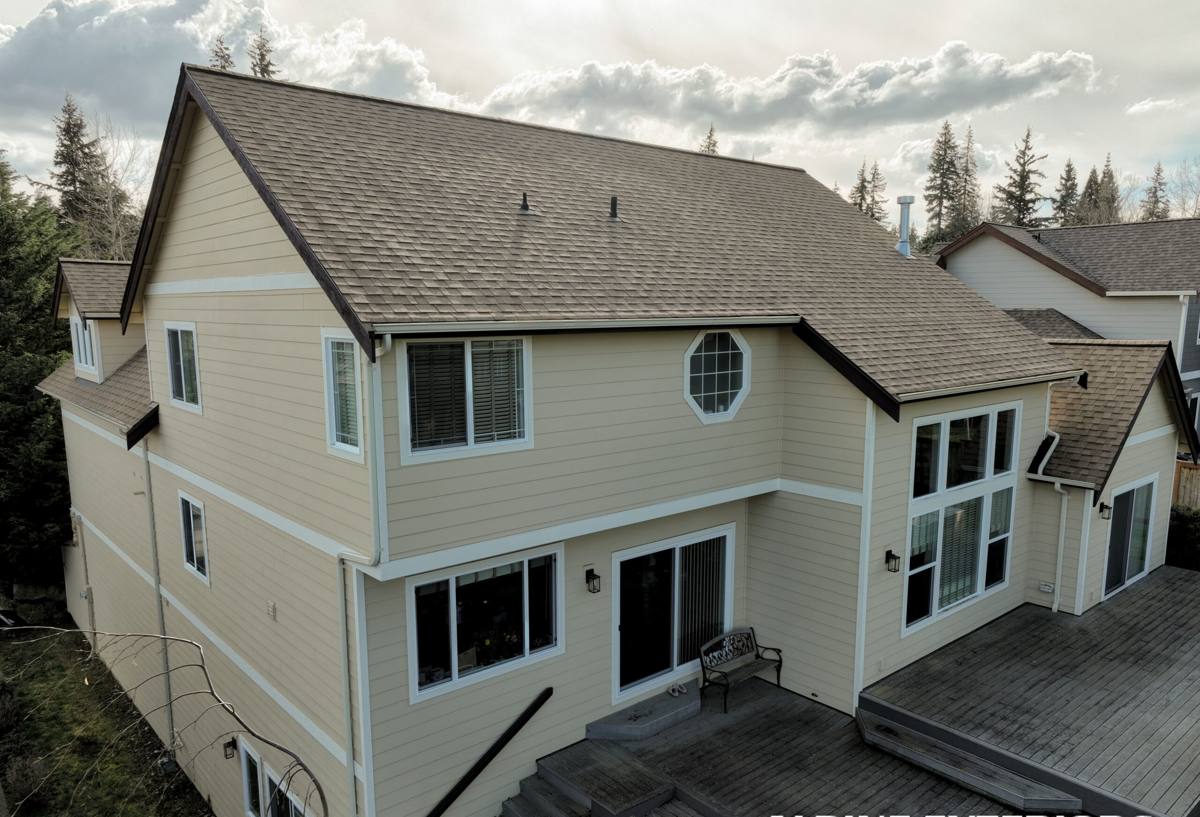
What Storm Damage Actually Looks Like Here
After a windstorm or a hard rain event, storm damage on a Shoreline roof rarely shows up as one obvious problem. It's usually a combination of smaller issues that add up.
Wind Damage
Gusts off the Sound can lift shingle edges, crease them, or tear them loose entirely, especially on roof faces that catch wind coming across open water. Once a shingle's seal is broken, it may look intact from the ground but no longer functions as a water barrier.
Rain-Driven Damage
Heavy, wind-driven rain doesn't just fall straight down — it gets pushed sideways and upward under laps, around flashing, and into any gap a calmer rain would never reach. This is where a lot of hidden leaks start, often at chimneys, skylights, and roof-to-wall transitions.
Moss and Long-Term Moisture Damage
Moss itself rarely causes a storm, but it sets the stage for storm damage to do more harm. Moss holds moisture against the shingle surface, keeps decking damp longer after a storm passes, and can lift shingle edges enough for wind and rain to get underneath. A roof with heavy moss going into a storm season is at higher risk than a clean one.
Signs You Need a Professional Inspection After a Storm
Not every sign of storm damage is obvious from the ground, and some of the most telling ones show up inside the house rather than on the roof itself. After a significant windstorm or heavy rain event, it's worth checking for the following:
- Shingles or shingle pieces in the yard or gutters
- Visible gaps, lifted edges, or bare patches on the roof when viewed from the ground
- New water stains on ceilings or around light fixtures
- Damp or musty smells in the attic or top-floor closets
- Granules collecting at the bottom of downspouts
- Bent, missing, or displaced flashing around chimneys and vents
Any one of these on its own might not mean serious damage, but after a storm they're worth a professional look rather than a wait-and-see approach, particularly in King County, where another wet system is often not far behind the last one.
Why a Few Replaced Shingles Isn't Always Enough
It's tempting to treat storm damage repair as swapping out the shingles that are obviously missing or torn. On a lot of Shoreline roofs, that approach leaves the underlying problem unaddressed. If wind-driven rain got under the roofing system during the storm, the underlayment, decking, and flashing nearby may already be wet even though the shingles above them look replaceable rather than ruined.
A correct repair means checking beyond the damaged shingles themselves: the felt or synthetic underlayment underneath, the condition of the decking, and whether flashing around penetrations moved or corroded. Skipping that check is how a homeowner ends up with a second, worse repair a year later — and trapped moisture left behind a quick patch is exactly the kind of thing that turns into hidden rot or mold before it's noticed again.
What a Correct Repair Involves
Every storm damage job is different, but the scope generally comes down to a handful of factors. The table below outlines what typically drives the size and cost of a repair.
| Factor | Why It Matters | Typical Impact on Scope |
|---|---|---|
| Extent of shingle loss | Determines whether it's a spot repair or a larger section replacement | Small / Moderate / Large |
| Underlayment condition | Wet or damaged underlayment must come out, not just be covered over | Adds material and labor |
| Decking condition | Water-softened plywood or sheathing needs to be replaced before new roofing goes down | Can add significant cost if rot is found |
| Flashing condition | Bent, corroded, or improperly sealed flashing is a common re-leak point | Often replaced during repair, not reused |
| Moss and debris buildup | Must be cleared to properly inspect and reseal the repair area | Added prep time |
| Roof access and pitch | Steeper or harder-to-reach roof sections take longer to work safely | Affects labor time |
Broad honest ranges: a straightforward, contained repair on an accessible roof section is usually a modest expense measured in a few hundred to low thousands of dollars. Repairs that involve decking replacement, extensive flashing work, or a large section of roof climb from there. We give an actual number after a physical inspection — anything quoted sight-unseen isn't worth much.
Our Storm Damage Repair Process
We keep the process straightforward because homeowners dealing with storm damage are usually already stressed about water getting into their home.
- Inspection. We walk the roof and check the attic or interior ceiling where accessible, looking for both obvious damage and the less obvious signs of moisture intrusion.
- Documentation. We photograph the damage clearly enough to support an insurance claim, if one is being filed.
- Temporary protection. If there's an active leak or exposed decking, we get it covered and weathertight before worrying about the permanent fix.
- Scope and estimate. We explain what we found, what needs to be replaced versus what can stay, and give a clear estimate before any repair work starts.
- Repair. We remove damaged shingles, underlayment, and any compromised decking; replace flashing where needed; and reroof the section to match the surrounding roof as closely as possible.
- Final check. We inspect the completed repair and the surrounding area to confirm there are no secondary issues we missed on the first pass.
Materials and Methods We Rely On
Given the salt air and moisture exposure common in Shoreline, we lean toward roofing systems and details that hold up under repeated wet-dry cycles rather than materials that look good initially but demand more maintenance over time. That means synthetic or high-quality underlayment that resists prolonged moisture exposure, corrosion-resistant flashing and fasteners suited to a coastal-influenced climate, and shingle products with wind ratings appropriate for the gusts this area sees off the water.
Repair Approach Depends on Roof Type
Composition asphalt shingle is the most common roofing type we repair in this area, but we also work on cedar shake and metal roofing, and each behaves differently after storm damage. Shake requires attention to how individual shakes weather and split; metal roofing repair is more about fastener backout and sealant failure at seams than lost material. We match the repair approach to what's actually on the roof rather than defaulting to one method for everything.
We're also careful about matching new material to existing roofing as closely as possible. A repair that stands out sharply in color or texture isn't just a cosmetic issue — mismatched or incompatible materials can also behave differently in wind and rain, which defeats the purpose of the repair.
Insurance Claims: What Homeowners Should Know
Many storm damage repairs in this area go through homeowners insurance, and a few general points make that process smoother. Document the damage as soon as it's safe to do so, even with basic photos from the ground. Avoid full replacement of undamaged sections before an adjuster has had a chance to see the actual damage, unless there's an active leak that needs immediate attention. And keep in mind that adjusters aren't roofers — a written estimate that clearly explains why underlayment or decking needs replacing, not just shingles, helps support a fair claim.
Larger repairs may also require a permit through the City of Shoreline or King County depending on scope; we handle that coordination as part of the job rather than leaving it for the homeowner to sort out. We're glad to provide documentation and a clear scope of work that a homeowner can hand to their insurance company, but we work for the homeowner, not the insurer.
After the Repair: Keeping Moss and Moisture From Coming Back
A good repair fixes the storm damage. Keeping it from recurring is mostly about managing the moisture and moss conditions that make future storm damage worse. A few habits go a long way:
- Keep gutters clear so storm runoff doesn't back up under the roof edge
- Trim back overhanging branches that keep shaded roof sections wet longer after a storm
- Have moss growth addressed before it thickens, rather than after it's already lifting shingle edges
- Check flashing and roof penetrations (vents, chimneys, skylights) at least once a year
- Address small leaks or missing shingles promptly rather than waiting for the next storm to make them worse
Why It Matters That We Already Work in Shoreline
Storm damage repair isn't just a generic skill — it's shaped by what a specific roof, in a specific climate, has already been through. A crew that regularly works Shoreline roofs has a working sense of which roof orientations take the worst of the wind off Puget Sound, how long moss really takes to become a problem in this area's shade and moisture, and what a proper repair needs to survive the next storm season rather than just look fixed for now. That local familiarity also means a faster response when a storm hits and a roof needs to be tarped or protected right away, rather than waiting on a crew that has to learn the area on the fly.
If a recent storm has left your roof with missing shingles, a new leak, or damage you're not sure how to assess, we're happy to take a look. Reach out for a free, no-pressure estimate — the form below gets you started.