 Seattle
 Why Green Lake's Setting Is Tough on Exterior Siding
Green Lake is one of Seattle's most heavily wooded residential neighborhoods, and that mature tree canopy is part of what makes it a desirable place to live. It's also part of what makes siding age faster here than it would on an open, sun-exposed lot. Shade slows drying time after every rain event, and King County gets a lot of rain events. Add in the marine air that moves through the greater Seattle area off Puget Sound, and you have a climate that keeps exterior wall surfaces damp for long stretches of the fall, winter, and spring.
Homes near the lake also deal with a long moss season. Moss doesn't need standing water to take hold — it just needs shade, moisture, and a surface it can grip. Wood lap siding, wood trim, and some engineered wood products give moss exactly that kind of surface. Once moss establishes itself against a wall, it holds moisture against the substrate underneath, which is where the real damage starts.
None of this means Green Lake homes can't have durable, good-looking siding. It means the material and the installation details matter more here than they would in a drier climate, and that's the lens we use on every siding job in this neighborhood.
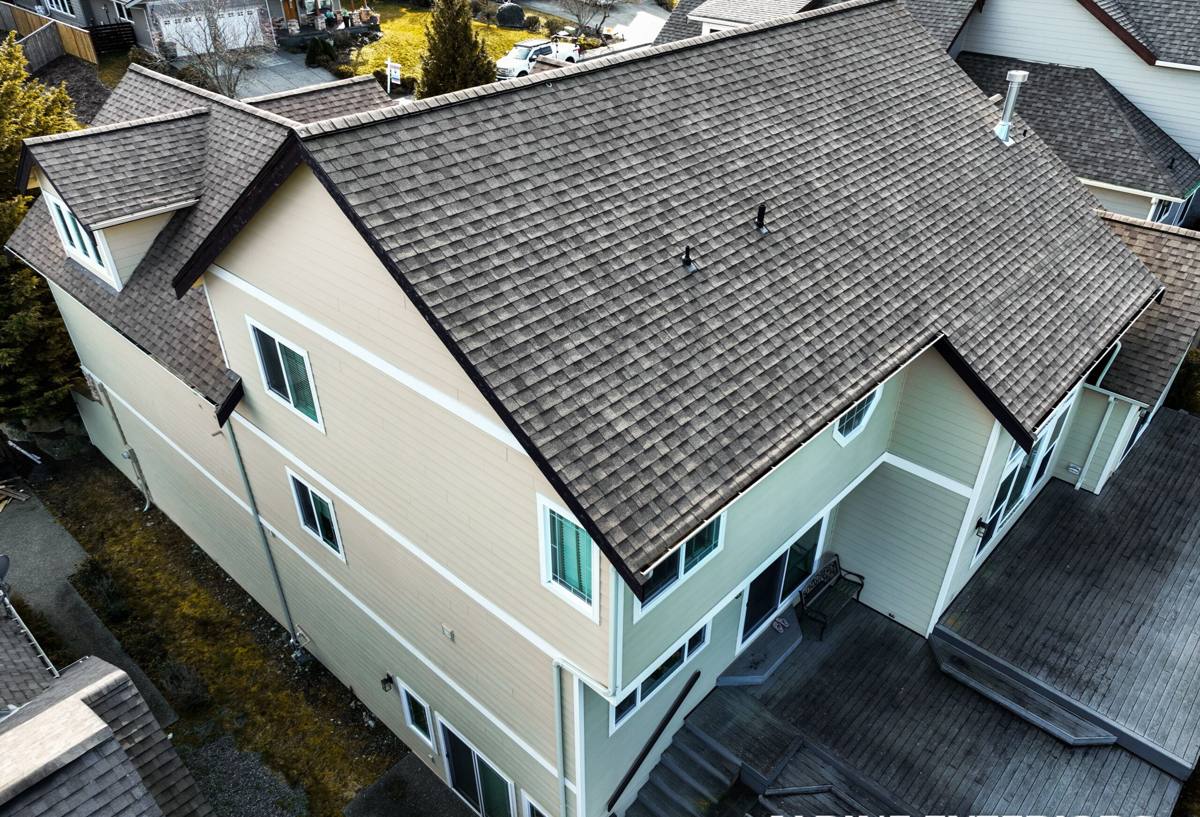
What Fiber Cement Actually Solves Here
Fiber cement siding is a mix of cement, sand, and cellulose fiber, pressed and cured into planks or panels. Unlike wood-based products, it isn't an organic food source for moss, mold, or insects, and it doesn't swell and split the way wood fibers do when they take on repeated moisture. That combination matters directly for a shaded, rain-heavy neighborhood like Green Lake:
- It resists moisture absorption far better than wood or wood-composite siding, so damp shade doesn't translate into swelling or cupping over time.
- It's non-combustible, which matters for insurance conversations and for peace of mind, independent of climate.
- It holds paint and factory finishes far longer than wood, because it isn't expanding and contracting with every wet-dry cycle the way wood does.
- It doesn't provide the same food source for moss and mildew that wood fiber does, which reduces (though doesn't eliminate) how often a shaded wall needs to be cleaned.
Fiber cement isn't magic — it still needs to be installed correctly and it still needs periodic cleaning in a shaded, wet environment. But it starts from a much stronger baseline than wood, engineered wood, or vinyl for this kind of lot.
Why We Only Install James Hardie
Fiber cement is a category, not a single product, and the manufacturer matters. We install James Hardie exclusively — not LP SmartSide, not vinyl, not Cemplank, not Allura, not primed spruce or cedar — and we tell homeowners why rather than just stating it as a policy.
Climate-engineered product lines
Hardie builds region-specific formulations (their HZ product lines) engineered for the moisture and temperature patterns of a given climate zone, rather than shipping one generic formulation everywhere. For a wet, shaded Pacific Northwest lot, that engineering is aimed at exactly the conditions Green Lake homes deal with all winter.
Factory-applied ColorPlus finish
Hardie's ColorPlus finish is baked on at the factory under controlled conditions, which gives it better adhesion and UV stability than field-applied paint. In a neighborhood where walls stay damp longer because of tree shade, a finish that's less prone to peeling and cracking at the surface is a real, practical advantage, not a marketing point.
Warranty and track record
Hardie backs its siding with a strong transferable warranty, which matters both for a homeowner planning to stay long-term and for resale value. It's also a product with decades of real installed history in wet coastal and marine climates, not just lab testing.
We won't install LP SmartSide, vinyl, or off-brand fiber cement products because we don't think they hold up as well against the specific combination of shade, rain, and moss pressure this area sees, and we'd rather turn down that work than install something we don't stand behind fully.
What a Correct Installation Involves
Fiber cement siding fails prematurely almost exclusively because of installation mistakes, not product defects. In a climate like Green Lake's, the margin for error is smaller than it would be somewhere dry, because any gap in the water-management details gets tested by rain far more often.
The details that matter most
- Water-resistive barrier and flashing — a continuous drainage plane behind the siding, with proper flashing at windows, doors, and every horizontal trim transition, so any moisture that gets behind the cladding has a path out.
- Clearances — correct gaps at the ground, roofline, and decks so siding isn't sitting in standing water or trapped against another surface that holds moisture.
- Fastening pattern — Hardie specifies exact nailing patterns and fastener types; over-driven or misplaced fasteners crack the board or open a path for water intrusion.
- Joint and butt-seam treatment — properly caulked or flashed seams, since this is where most water intrusion problems actually start.
- Painting and caulk products — matched to Hardie's specifications so the finish system performs as engineered rather than fighting the substrate.
Get any one of these wrong and you can end up with moisture problems behind fiber cement siding that look, from the street, exactly like a well-installed job — until the damage shows up years later as rot in the sheathing or framing underneath.
Comparing Siding Options for a Shaded, Wet Lot Like Green Lake
| Material | Moisture behavior in shade | Moss/mold resistance | Finish durability | Typical lifespan |
|---|---|---|---|---|
| James Hardie fiber cement | Strong — engineered, low absorption | Good — non-organic substrate | Factory-baked ColorPlus, long-lasting | Decades with proper install |
| Vinyl siding | Doesn't absorb water, but traps moisture behind panels if flashing is poor | Moderate — surface can still host growth | Color fades and becomes brittle over time | Moderate, shorter in harsh sun/cold cycling |
| LP SmartSide / engineered wood | Wood-fiber core is moisture-sensitive at cut edges and damage points | Weaker — organic substrate | Field or factory finish, depends on maintenance | Shorter if moisture reaches the core |
| Cedar or primed spruce | Absorbs and releases moisture constantly; swells/shrinks with weather | Weakest — natural food source for moss/mildew | Requires repainting/staining on a recurring cycle | Shortest without frequent maintenance |
This is why fiber cement, and specifically Hardie's climate-engineered version of it, is what we recommend for shaded, rain-exposed lots rather than treating all siding materials as roughly interchangeable.
Moss, Shade, and Ongoing Maintenance
Even with fiber cement siding, a heavily treed lot near Green Lake needs a basic maintenance rhythm. Moss and mildew growth on the surface of siding is mostly a cosmetic and gutter-adjacent issue rather than a structural one when the siding and flashing were installed correctly — but ignoring it for years can let organic buildup hold moisture against caulked joints and trim longer than it should.
A simple, realistic maintenance routine for a shaded Green Lake property includes rinsing down north-facing and heavily shaded walls periodically, keeping gutters clear so overflow isn't running down the siding face, and keeping vegetation trimmed back a few inches from exterior walls so airflow can help surfaces dry between storms. None of this is unique to fiber cement — it's just more forgiving of an imperfect maintenance schedule than wood siding would be.
Our Process for a Green Lake Siding Project
We approach every fiber cement job in this neighborhood the same structured way:
- On-site assessment — we look at existing siding, sheathing condition where accessible, drainage patterns around the foundation, and how much sun exposure each elevation actually gets given the tree canopy.
- Product and finish selection — choosing the right Hardie plank profile, exposure, and ColorPlus color for the home's style and the homeowner's preference.
- Permitting — siding replacement in Seattle typically requires review through the city's permitting process; we handle that coordination rather than leaving it to the homeowner.
- Tear-off and prep — removing old siding, inspecting and repairing sheathing or framing where needed, and installing a proper water-resistive barrier before any new siding goes up.
- Installation to Hardie's specification — correct fastening, flashing, clearances, and seam treatment, not shortcuts that only show up as problems later.
- Final walkthrough — checking caulk lines, paint touch-ups, and trim details before we call the job done.
What to Ask Before Hiring a Siding Crew in This Area
- Do they install to the manufacturer's written specifications, or their own shortcut version?
- Will they inspect and address sheathing or moisture damage discovered during tear-off, rather than siding over it?
- Do they handle Seattle permitting themselves, and can they explain what triggers a permit for a given scope of work?
- Have they worked on homes in shaded, tree-heavy lots like those around Green Lake, and can they speak specifically to moisture and drainage details?
- Are they licensed and insured for exterior work in Washington, and will they put warranty terms in writing?
Why Local Experience in Green Lake Matters
A lot of the housing stock in and around Green Lake is older, with a mix of bungalows, craftsman-style homes, and mid-century construction — each with different sheathing types, trim details, and existing moisture histories behind the walls. A crew that already works this specific neighborhood has a feel for what's likely hiding behind older siding before the first board comes off, and for how much shade and drainage vary block to block around the lake. That local pattern recognition is worth more than a lower bid from a crew that treats every job in King County the same way, sun-exposed or not.
If you're weighing a siding project on a Green Lake home, we're glad to walk the property, look at what's there now, and put together a straightforward, no-pressure estimate for a correctly installed James Hardie system. There's no obligation — just an honest look at what your home actually needs.