 Seattle
 Siding Built for Renton's Rain, Humidity, and Moss
Renton sits in the Green River Valley at the south end of Lake Washington, in a part of King County that gets the full range of what a Pacific Northwest winter can throw at a house — weeks of low gray drizzle, occasional heavy rain systems moving in off Puget Sound, and the kind of standing humidity that settles into low-lying valley air. Homes down near the lake and the Cedar River tend to sit in more shade and moisture; homes up on the surrounding hillsides catch more wind-driven rain and direct exposure. Either way, siding here isn't a cosmetic decision. It's the first line of defense against moisture that shows up nearly every month of the year.
That mix — marine-influenced air, driving rain, and a moss season that can realistically run from early fall through late spring — is exactly why so much siding in this region fails years before it should. Moisture gets trapped behind the cladding, paint can't keep pace with the humidity, and anything with texture or seams gives moss and algae somewhere to take hold. We install one product system, James Hardie fiber cement, because it's engineered for this specific combination of conditions, and we install it to a standard that respects how Renton weather actually behaves rather than how a spec sheet describes it.
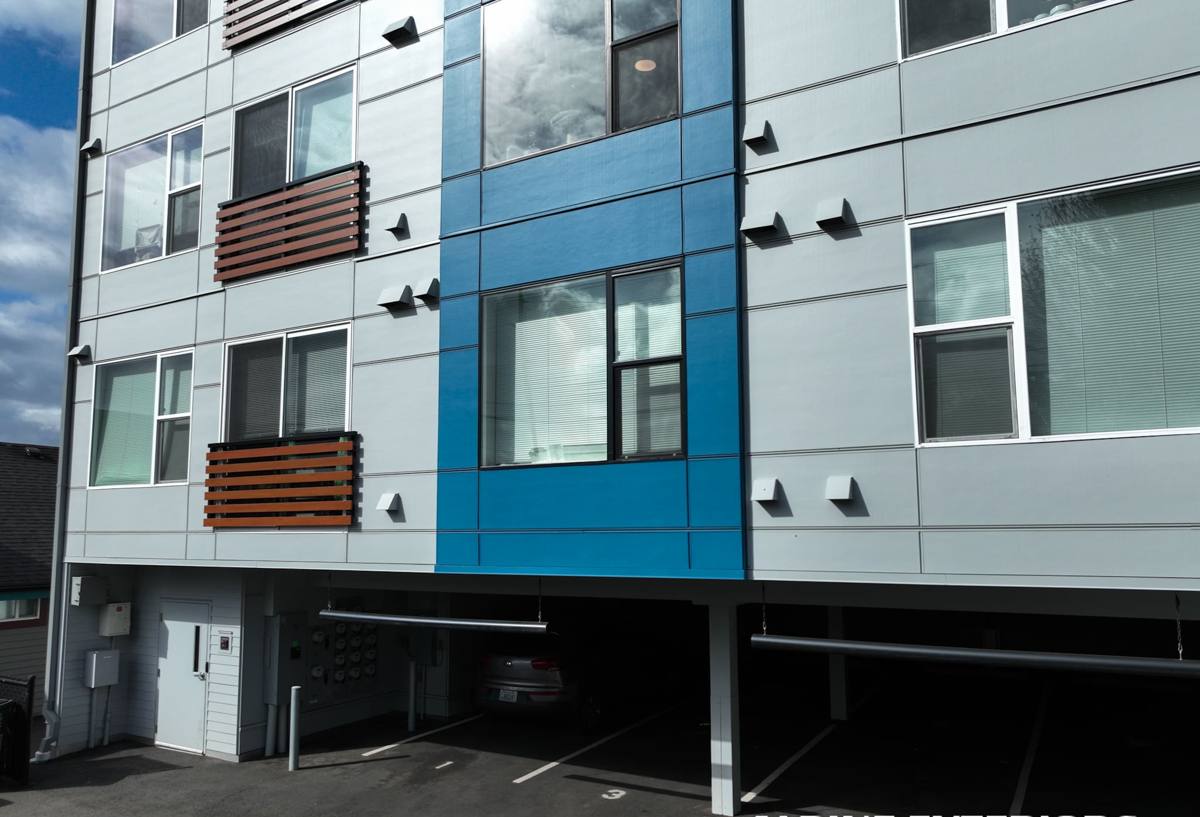
What This Climate Does to the Wrong Siding
Moss and Organic Growth
Moss and algae aren't just an appearance problem. They need moisture, shade, and a surface to grip, and a lot of Renton lots — especially anything with mature trees or a north-facing wall — provide all three for most of the year. On porous or textured siding, spores settle into the surface itself and hold water against the substrate long after a storm has passed. Over a few seasons, that constant damp cycle can soften wood-based products, lift paint, and accelerate rot at seams and butt joints. Fiber cement doesn't stop moss from landing on it, but it doesn't feed the problem the way organic or absorbent materials do, and a properly painted ColorPlus finish gives growth much less to grab onto.
Humidity and Trapped Moisture
The bigger long-term threat is what happens behind the siding, not on top of it. Valley humidity and repeated rain cycles push moisture toward any gap, and if that moisture has nowhere to escape, it sits against the sheathing and framing. Wood-based sidings expand and contract with that moisture, which stresses joints and finishes. Vinyl doesn't absorb water itself, but it also does very little to manage what gets behind it, and it can warp or gap over time with temperature swings, leaving more room for wind-driven rain to work its way in. This is why the installation details — not just the material — determine whether a siding job holds up through a Renton winter or starts failing quietly within a few years.
What a Correct Siding Installation Actually Involves
The Weather-Resistive Barrier Comes First
Before a single piece of siding goes up, the wall needs a continuous weather-resistive barrier, properly lapped and sealed at every penetration — windows, doors, hose bibs, light fixtures, vents. This layer, not the siding itself, is what actually keeps bulk water out of the wall assembly. Skipping or rushing this step is one of the most common causes of hidden moisture damage we find when we tear off old siding on Renton homes, and it's invisible once the new siding is up, which is exactly why it has to be done right the first time.
Flashing, Clearances, and Fastening
James Hardie siding has to be installed to the manufacturer's specifications to keep its warranty valid and to actually perform the way it's designed to — that means correct flashing above windows and doors, proper head and side clearances, minimum ground clearance to keep splash-back moisture off the bottom edge, and fasteners driven to the right depth and spacing. Over-driven nails crack the board's finish and create entry points for water; under-driven ones leave the board loose and prone to movement. None of this is exotic knowledge, but it's easy to shortcut on a job priced too low or crewed by installers who don't do fiber cement full-time, and the mistakes don't show up until a few wet seasons in.
Why We Install Only James Hardie Fiber Cement
We made a decision years ago to install one siding system and install it well, rather than offer every product on the market and hope each one performs. James Hardie fiber cement is non-combustible, holds its factory-applied ColorPlus finish far longer than field-painted wood products, and its HZ5 line is engineered specifically for climates like this one — freeze-thaw cycles, sustained moisture, and the temperature swings that come with a marine climate. It costs more up front than vinyl or engineered wood, and it's heavier and less forgiving to install, which is precisely why we don't treat it as a side offering. A product built for this climate only performs like it's built for this climate when it's installed by people who install it constantly.
Comparing Siding Materials for a Renton Home
| Material | Moss/Moisture Behavior | Maintenance | Typical Lifespan |
|---|---|---|---|
| James Hardie fiber cement | Non-combustible, dimensionally stable, factory finish resists moss/algae staining | Occasional wash-down; no repainting for many years under normal use | Decades when installed to spec |
| Vinyl | Won't rot, but can warp/gap over time, letting moisture behind it | Low, but damaged panels are hard to color-match years later | 15-25 years, shorter with UV and impact stress |
| Cedar/wood | Absorbs moisture, feeds moss and rot without diligent upkeep | Regular refinishing, sealing, and repair | Highly maintenance-dependent |
| LP SmartSide (engineered wood) | Treated to resist moisture but still wood-based; seams and cut edges are moisture-sensitive | Moderate; edge sealing and repainting over time | Maintenance-dependent, shorter than fiber cement in wet climates |
This is a general comparison, not a claim that every alternative product fails — plenty of siding materials can perform adequately with diligent upkeep. It's simply why, for the moisture load a Renton home carries most of the year, we've standardized on the one system built specifically for it.
Our Installation Process
- On-site inspection of the existing siding, trim, and any visible moisture or rot damage, with photos to document what we find.
- A written estimate that separates material, labor, and any sheathing or framing repair that comes up once old siding is removed.
- Full tear-off of the old siding and inspection of the sheathing underneath before anything new goes on.
- Repair of any damaged sheathing or framing discovered during tear-off — this gets discussed with you before we proceed.
- Installation of a continuous, properly lapped weather-resistive barrier with sealed penetrations at every window, door, and fixture.
- Installation of James Hardie fiber cement siding and trim to manufacturer fastening, flashing, and clearance specifications.
- Final walk-through so you can see the finished work and ask questions before we consider the job complete.
Signs Your Renton Home May Need New Siding
- Persistent moss or dark streaking that returns within weeks of being cleaned off
- Paint that's peeling, bubbling, or chalking faster than it used to
- Soft spots, warping, or visible gaps at seams and butt joints
- Rising energy bills that suggest the wall assembly is no longer keeping conditioned air in
- Visible rot or staining around window and door trim
- Siding that's original to a home built decades ago and has never been fully replaced
Any one of these on its own might just need a repair. Several together usually mean the siding system as a whole has reached the end of what patching can fix.
Why a Crew That Already Works in Renton Matters
Renton isn't one uniform building environment — a lot near the lake or the Cedar River behaves differently than a lot up on the surrounding hillsides, and older homes closer to the valley floor often have different sheathing and moisture histories than newer construction further out. A crew that already works this area regularly has a feel for which lots tend to hold moisture, what King County permitting and inspection expects for exterior work, and how local weather patterns actually play out across a job that can stretch over a couple of weeks. That local familiarity doesn't replace doing the installation correctly, but it does mean fewer surprises, fewer change orders, and a crew that isn't learning the area on your dime.
If your Renton home's siding is showing its age, or you're planning ahead rather than waiting for a problem to force the decision, we're happy to take a look and give you a straight, no-pressure assessment. Use the form below to request a free estimate, and we'll walk the exterior with you and explain exactly what we see.