 Seattle
 Composite Decking in Redmond: What the Climate Actually Demands
Redmond sits inland from Puget Sound, tucked among mature trees and close to Lake Sammamish, but it still gets the same wet, gray stretch of fall-through-spring weather that defines the rest of King County. What makes Redmond's situation a little different from a waterfront lot is shade. Tree-lined yards and wooded lots hold onto moisture longer after a storm passes, and a deck tucked under a canopy can stay damp for days when a sunnier lot down the road has already dried out. Add in the driving rain that blows through the region several months a year, and you've got the two conditions that do the most damage to an outdoor deck: standing moisture and slow drying time.
A wood deck in that environment needs regular sealing, staining, and inspection to keep water out of the grain. Skip a year and you'll see graying, splintering, and the early stages of rot in the joists below. Composite decking was designed to take that maintenance burden out of the equation, but only if it's installed correctly for this specific climate. A composite deck built the same way you'd build one in a dry inland climate will still trap moisture underneath, grow moss and algae on shaded boards, and fail early around fasteners and ledger connections. The product matters, but the installation matters more.
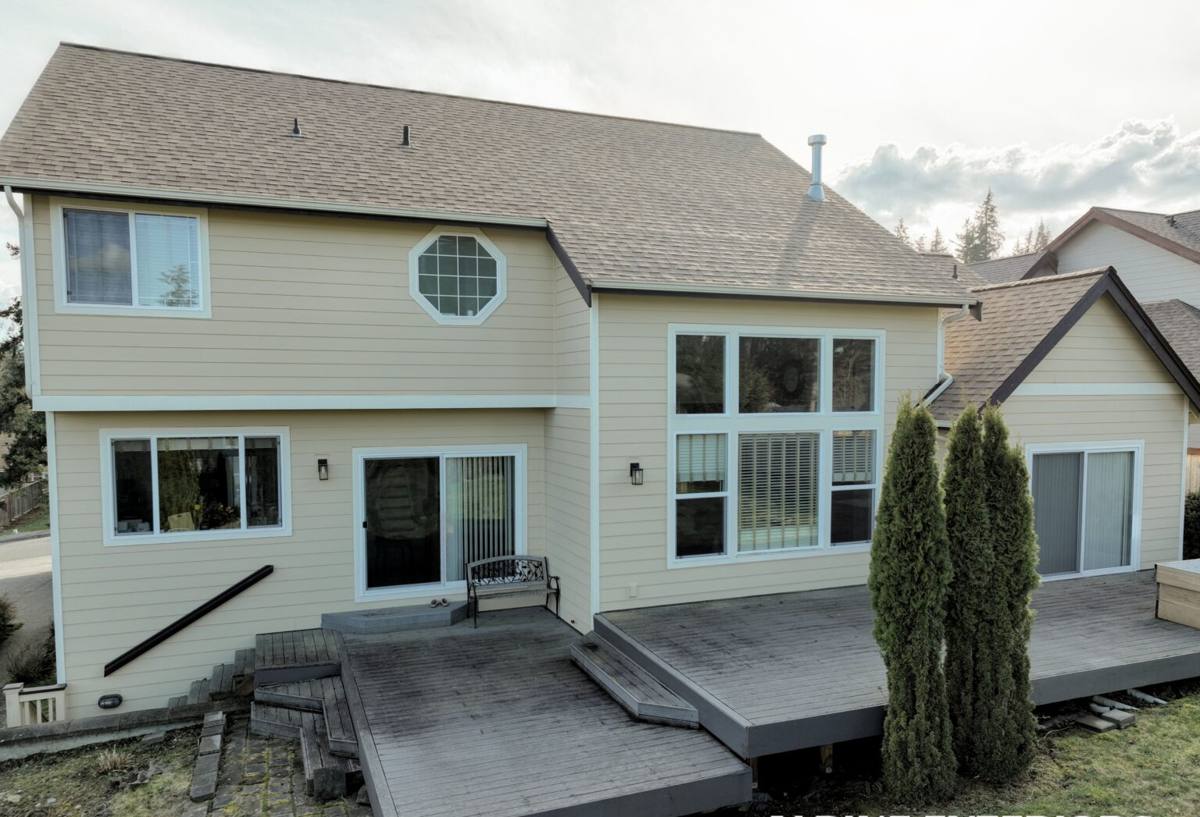
Why Composite Makes Sense for Redmond Homes
We install wood, composite, and PVC decking, and each has a place. For a shaded King County lot with a long wet season, composite is usually the more honest recommendation for a homeowner who wants a deck that looks good in ten years without a maintenance calendar attached to it.
| Material | Moisture behavior | Moss/algae resistance | Maintenance | Typical lifespan |
|---|---|---|---|---|
| Pressure-treated wood | Absorbs water, swells and shrinks seasonally | Low — bare wood holds spores | Annual cleaning, sealing/staining every 1-2 years | 10-15 years with upkeep |
| Capped composite | Polymer shell sheds surface water | Higher — smoother, less porous surface | Periodic washing, no sealing/staining | 25-30+ years, warrantied |
| Uncapped composite | Wood-plastic blend can still absorb some moisture | Moderate — more porous than capped boards | Regular cleaning to prevent staining | 15-20 years |
| PVC decking | No wood content, essentially moisture-inert | High | Occasional washing | 25-30+ years |
None of these are wrong choices in the abstract — a lot of it comes down to budget and how the yard sits relative to sun and tree cover. What we won't do is sell an uncapped or budget composite board for a heavily shaded lot and let the homeowner find out the hard way that it still needs the same washing schedule as wood. We'd rather explain the trade-off up front.
Being honest about wood decking
Some homeowners still prefer the look and feel of real wood, and we're happy to build that. Our job is to make sure you know what you're signing up for: a wood deck in a shaded Redmond yard needs more frequent attention than the same deck would need in a drier, sunnier part of King County. That's not a knock on wood — it's just physics.
What a Correct Composite Deck Install Actually Involves
Framing and ledger connection
Composite decking is heavier and behaves differently under load and temperature change than dimensional lumber. The substructure — joists, beams, posts, and footings — has to be sized and spaced to the manufacturer's specification for the specific board being used, not just built to a generic deck framing standard. The ledger board, where the deck attaches to the house, is one of the most common failure points on older decks we're asked to repair or replace. It needs proper flashing to keep water from working its way behind the siding and into the rim joist, which is exactly the kind of slow, hidden rot that a long rainy season in King County is good at creating.
Fastening and board spacing
Composite boards expand and contract with temperature more than wood does. Hidden fastener systems, correct gap spacing between boards, and picture-framing details at the perimeter all have to account for that movement, or you end up with buckling, popped fasteners, or gaps that widen unevenly over a few seasons.
Drainage and airflow underneath
This is the detail that matters most for a shaded Redmond lot. The ground and framing underneath a deck need a clear path for water to drain away and air to move through, so the underside of the deck can actually dry out between storms. On sloped or low-lying yards, that sometimes means adding drainage away from the foundation or grading under the deck itself. Skip this step and you're building a dark, damp cavity that stays wet for weeks at a time — ideal conditions for mold and for accelerated wear on framing hardware, regardless of how good the decking on top is.
Choosing the Right Board for a Shaded, Wet Yard
Capped vs. uncapped composite
Capped composite boards have a polymer shell wrapped around a wood-composite core. That shell is what sheds water, resists staining, and keeps moss and algae from taking hold as easily on boards that sit in shade most of the day. For lots with real tree cover — common across Redmond neighborhoods — we generally steer homeowners toward capped composite or PVC over uncapped composite, simply because uncapped boards behave more like wood when it comes to surface moisture and staining over time.
Color and heat
Darker composite boards read as premium and hide dirt well, but they also absorb more heat in direct sun and can dry out faster. In a shaded yard that's less of a concern; on a lot with more open exposure, a lighter or variegated color can keep the deck more comfortable underfoot in summer while still resisting the wet-season issues that matter more here.
Grooved vs. solid-edge boards
Grooved boards allow hidden fastener systems for a clean, screw-free surface, but the grooves themselves can hold moisture and debris longer if the gaps aren't kept clear. Solid-edge boards with face fastening are easier to keep clean in a yard with heavy leaf drop, which is worth discussing if you're under mature trees.
Our Process, Start to Finish
- On-site assessment of the yard's sun/shade exposure, drainage, and existing structure (if replacing an old deck)
- Straightforward walkthrough of board options and trade-offs based on how your specific lot behaves
- Design and layout, including railing, stairs, and any picture-framing or fascia details
- Permitting through the appropriate local jurisdiction before any work begins
- Demolition of the old deck (if applicable) and inspection of ledger, framing, and footings
- Framing built to the manufacturer's engineering spec for the chosen composite product
- Ledger flashing and drainage detailing to keep water out of the house and moving away from the structure
- Composite board installation with correct fastening, spacing, and expansion gaps
- Final walkthrough covering care and what to expect through the first wet season
Living With a Composite Deck Through King County's Wet Season
One of the real advantages of composite decking is how little upkeep it needs compared to wood, but "low maintenance" doesn't mean "no maintenance," especially under tree cover. A few habits go a long way:
- Sweep leaves and organic debris off the deck regularly in fall — trapped, wet leaves are what actually feeds moss and algae growth
- Rinse or wash the deck surface a couple of times a year, more often in heavily shaded spots, using a soft brush and a cleaner rated for composite decking
- Keep gutters and downspouts directing water away from the deck structure, not onto or under it
- Check that the gap between boards stays clear so water can drain through rather than pooling on the surface
- Walk the underside of the deck once a year to confirm airflow paths haven't been blocked by stored items, plants, or debris buildup
What Drives the Cost
Every composite deck project is priced around the specifics of the yard and the scope of work, so we don't quote a flat number without seeing the site. In general, the factors that move the price up or down are:
| Factor | Why it matters |
|---|---|
| Deck size and shape | Square footage and complexity of the layout (angles, multiple levels) affect both material and labor |
| Condition of existing structure | Replacing framing, footings, or a compromised ledger adds scope beyond a simple resurface |
| Board tier | Uncapped composite, capped composite, and PVC sit at different price points |
| Railing and stair details | Composite, metal cable, or glass railing systems vary widely in cost |
| Site access and grading | Sloped lots or limited equipment access can add labor time |
| Permitting requirements | Scope and height of the structure determine what's required locally |
Why a Crew That Already Works Redmond Matters
Decking looks like a simple trade from the outside, but the difference between a deck that lasts twenty-five years and one that starts failing at year eight almost always comes down to details that aren't visible once the boards are down — ledger flashing, framing spec, drainage, and fastener choice. A crew that regularly works in and around Redmond has already seen how shaded, tree-covered lots behave differently than open ones, understands the drainage and grading issues common to King County's wet season, and knows the local permitting process well enough to keep a project moving instead of stalled. That familiarity doesn't show up in a brochure, but it shows up in how the deck holds up five winters from now.
Signs Your Current Deck Needs Attention
- Boards that feel spongy, soft, or visibly sagging underfoot
- Persistent green or black staining that comes back quickly after cleaning
- Gaps around the ledger board or staining on the siding directly above the deck
- Fasteners that have popped, rusted, or pulled loose from the boards
- Visible moss or standing water that doesn't clear within a day of a dry spell
- Railings or stair stringers that feel loose or have visible rot at the base
If your deck shows any of that, it's worth having someone look underneath, not just at the surface. A deck that looks fine on top can still have a framing or drainage problem doing damage out of sight.
If you're planning a new composite deck or replacing one that's past its prime, we're happy to walk your yard, look at sun exposure and drainage, and put together a straightforward, no-pressure estimate — just fill out the form below to get started.