 Seattle
 New-Construction Windows Are a Different Job Than Replacement
When people call us about "new windows," most of the time they mean replacement — swapping out old units in an existing wall. New-construction window work is a different animal. It happens on a framed, open rough opening: a new build, a teardown-rebuild, an addition, or a garage or ADU conversion where the wall doesn't exist yet as a finished surface. The window goes in with a nailing flange, tied directly into the sheathing, the weather-resistive barrier, and the flashing system before siding ever goes on.
That distinction matters because a new-construction install is a one-shot opportunity. Once the siding crew closes up the wall, nobody sees the flashing details again unless something goes wrong. In Kirkland, where teardown-rebuilds, additions, and second-story pop-tops are common in older neighborhoods being upgraded, we see a lot of these openings — and we treat every one of them as the last chance to get water management right before it's buried.
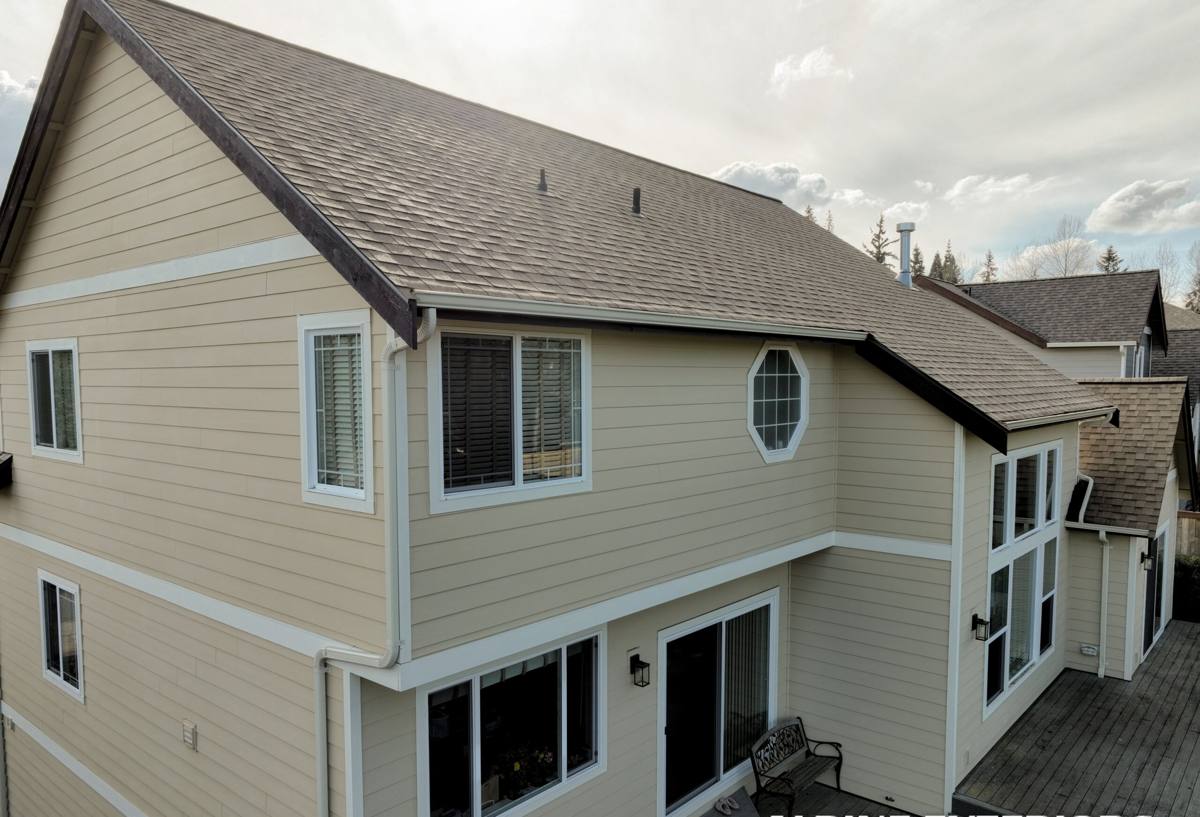
Why Kirkland's Climate Raises the Stakes on This Job
Kirkland sits on Lake Washington in King County, in a stretch of the Puget Sound region that gets driving, wind-pushed rain rather than the gentle straight-down kind. Add a long wet season that runs roughly October through May, humid marine air off the lake and Sound, and long stretches without real drying weather, and you get conditions that are unforgiving of shortcuts. A window opening that's slightly out of sequence — sill pan skipped, house wrap lapped the wrong way, a bead of caulk asked to do a flashing's job — won't necessarily leak on day one. It leaks the first time we get a real atmospheric river event, and by then the sheathing has often been wet, on and off, for a season or two.
The same damp, low-light conditions that grow moss on north-facing roofs and siding around here also favor mold and rot inside a wall cavity that's staying wet longer than it should. New-construction windows give us the chance to build the drainage path correctly from the studs out, instead of fighting an already-finished wall later.
What Homeowners Usually Don't See Coming
Most water intrusion around new windows isn't a dramatic leak — it's a slow, sneaky one. Common signs it's been happening for a while include soft or discolored trim, a musty smell near a window on a rainy week, or paint failing on the interior sill months after move-in. By the time any of that shows up, the fix usually means opening up finished wall, not just re-caulking.
What a Correct New-Construction Window Installation Involves
There's a specific, well-established sequence for tying a window into a wall correctly. Skipping steps or doing them out of order is the single biggest cause of hidden water damage in new construction.
Sill Pan Flashing
Before the window ever sits in the opening, the sill gets a pan flashing — a sloped, back-dammed pan that sheds any water that gets past the window itself back out to the exterior instead of into the wall cavity. This is the step most often shortcut on lower-quality jobs, and it's the one that matters most in a climate with as much sustained rain as ours.
Housewrap Integration and the Drainage Plane
The window flange has to be integrated with the house wrap in the correct shingle-lap order: sill pan first, then the window set into it, then jamb flashing tape up both sides, then the head flashing lapped over the top so water always drains down and out over the layer below it, never into a seam. Done correctly, a continuous drainage plane runs from the roof down past every window to the foundation. Done out of order, you've built a shelf for water to collect on.
Fastening, Shimming, and Squaring
New-construction flanges get nailed off per the manufacturer's fastening schedule — not "a nail every foot," but a specific pattern and fastener type the warranty is actually built around. The unit also has to be shimmed square, level, and plumb before it's fastened, or it will bind, leak at the corners, or fail its own weatherstripping prematurely.
Interior Air Sealing and Insulation
The gap between the rough framing and the window jamb needs a low-expansion foam or backer rod and sealant — enough to air-seal and insulate, not so much expanding foam that it bows the frame inward and causes the sash to bind. This step is easy to rush and easy to get wrong in both directions.
Choosing a Frame Material for This Climate
New construction is the best time to choose a frame material, because you're not constrained by an existing opening size the way a replacement job is. For a marine climate with long wet seasons, moisture resistance and low maintenance carry more weight than they might somewhere drier.
| Frame Material | Moisture Resistance | Maintenance | Relative Cost |
|---|---|---|---|
| Vinyl | Very good — won't rot or corrode | Low — occasional cleaning | Lower |
| Fiberglass | Excellent — dimensionally stable in wet/dry cycles | Low | Mid to higher |
| Vinyl-clad wood | Good on exterior; interior wood needs the seal to stay intact | Moderate | Higher |
| Aluminum-clad wood | Good, but clad seams need careful detailing at the sill | Moderate | Higher |
We don't push one material on every job. The right call depends on the exposure of that specific opening — a window under a deep eave on a protected wall has an easier life than one facing open weather on the lake side of a lot — plus budget and the look the design calls for. What we won't do is recommend a frame or cladding system whose long-term moisture behavior doesn't match how exposed the opening actually is.
Glazing and Performance Packages Worth Considering
Our climate is mild but overcast and heating-dominated more than cooling-dominated, which changes which glazing numbers actually matter.
- U-factor (how well the window resists heat loss) generally matters more here than solar heat gain coefficient, since we're not fighting intense summer sun the way hotter climates are.
- Low-E coatings are worth having on essentially every new-construction window in this region — they help retain heat through our long heating season.
- Double-pane with argon fill is the standard baseline for new construction now; triple-pane adds meaningful comfort and sound dampening at added cost and weight, and is worth discussing for street-facing or west-facing rooms.
- Condensation resistance is worth asking about directly — good glazing packages resist interior condensation better during our cold, humid winter mornings.
Coordinating With Builders and GCs
New-construction window work almost never happens in isolation — it's one piece of a framing-to-siding sequence run by a general contractor. We build our schedule around theirs: windows need to be measured off actual framed openings (not just plans, since field dimensions shift), ordered with enough lead time to avoid holding up the siding crew, and installed at the right point after house wrap goes on but before siding starts.
Kirkland is its own incorporated city with its own building department separate from unincorporated King County, so new-construction and addition projects here typically go through city permitting and inspection rather than the county's. We coordinate around inspection points so the flashing and drainage details are still visible and accessible when they need to be checked, instead of already covered by siding.
Our Installation Process, Start to Finish
- Review the rough openings against window schedule and framing plans, and verify actual field dimensions before ordering.
- Confirm frame material, glazing package, and hardware with the homeowner or builder.
- Install sill pan flashing at each opening, sloped and back-dammed.
- Set the window square, level, and plumb; shim and fasten per manufacturer specification.
- Integrate jamb and head flashing with the house wrap in correct shingle-lap order.
- Air-seal and insulate the interior perimeter gap without over-filling it.
- Walk every opening for operation, seal lines, and flashing continuity before siding starts.
- Coordinate with the GC or inspector on sign-off before the wall closes up.
Quality Checklist We Follow on Every New-Construction Window Job
- Sill pan flashing installed and sloped to drain outward, not just caulked flat
- House wrap and flashing tape lapped shingle-style, top layer always over the one below
- Fasteners match the manufacturer's schedule for type, spacing, and location
- Unit is square, level, and plumb before final fastening — checked, not assumed
- Shim spacing supports the frame without distorting it
- Interior gap sealed and insulated without over-packing expanding foam
- Every unit operates smoothly and seals fully before the wall is closed in
- Flashing details photographed or documented before they're covered, for the homeowner's and builder's records
Why a Crew That Already Works in Kirkland Matters
New-construction window work rewards familiarity — with the local building department's inspection expectations, with how exposed a given lot is to wind-driven rain off the lake, and with which framing and siding crews we've already coordinated a clean sequence with before. A crew that only occasionally works this area is learning those things on your project. A crew that works Kirkland regularly has already made the adjustments this climate calls for, and knows what a passing inspection actually looks like here.
If you're framing an addition, a rebuild, or a new home in Kirkland and want the window openings done right the first time, we're glad to take a look and walk through the details with you. Fill out the form below for a free, no-pressure estimate.