 Seattle
 Redmond's Climate Puts Real Demands on Siding
Redmond sits inland from Puget Sound, tucked between Lake Washington and Lake Sammamish, with a tree canopy that shades a lot of siding for most of the day. That combination means less direct sun to dry a wall after rain, more standing humidity under mature trees, and a long stretch of the year — roughly October through April — where siding rarely gets a real chance to dry out completely between storms. Add in the driving rain that blows through King County during winter fronts, and the broader marine air that carries moisture and salt content off Puget Sound, and you have a climate that is quietly hard on exterior materials even when it doesn't look extreme on any given day.
The result homeowners actually see is moss and algae growth on shaded elevations, paint and caulking that fail years earlier than the label promised, and trim boards or panel edges that swell and soften where water sits against them. None of this is dramatic. It's cumulative. A siding product that's marginal in a drier climate becomes a real maintenance problem in Redmond, which is why the material and the installation details matter more here than they would in a place with less rain and less shade.
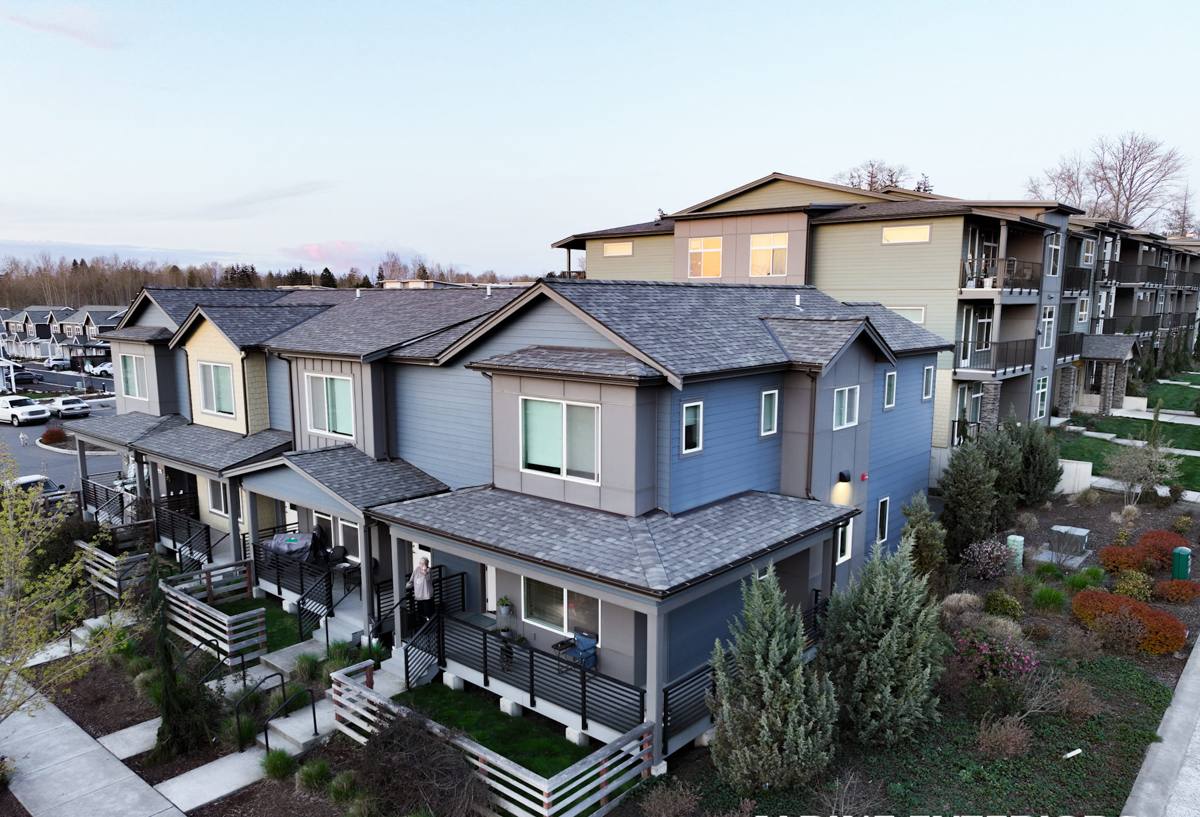
What James Hardie Siding Does Specifically for a Redmond Home
James Hardie fiber cement is cement, sand, and cellulose fiber, not wood and not vinyl. That composition matters directly for Redmond's conditions:
- It does not absorb water the way wood-based products do, so it does not swell, cup, or rot at cut edges and butt joints the way engineered wood siding can when moisture gets in.
- It's dimensionally stable across wet and dry cycles, which matters in a climate that swings between soaked winters and drier summers — less movement means caulking and paint lines hold longer.
- It's non-combustible, which is a genuine safety benefit given how close many Redmond lots sit to mature trees and landscaping.
- The factory-applied ColorPlus finish is baked on under controlled conditions, so it resists the fading and peeling that field-applied paint struggles with under repeated damp-dry cycling.
James Hardie also makes climate-specific product lines. For the Pacific Northwest, that means HZ10 formulations, engineered for high-moisture, high-humidity regions rather than a one-size-fits-all product. That's a meaningful distinction for a shaded, damp Redmond lot versus a dry-climate installation, and it's part of why we don't treat "Hardie siding" as a single generic product — we spec the version built for this region.
Moss and Algae: Material Helps, Detailing Decides
No siding material is immune to moss and algae on a heavily shaded north or east elevation. What fiber cement offers is a surface that doesn't feed organic growth the way untreated wood can, and a substrate that won't degrade underneath a moss patch even if one does form. But the bigger factor in how much moss a Redmond home actually develops is airflow and drainage behind the siding — which comes down to installation, not the product itself. That's a theme that runs through everything below: the material gives you a strong starting point, but the install determines whether that advantage is realized over 20-plus years.
Why Not Other Siding Products for This Climate
We get asked fairly often why we don't offer vinyl, LP SmartSide, cedar, primed spruce, or other fiber cement brands as alternatives. The honest answer is a set of trade-offs that show up hardest in exactly the conditions Redmond has — shade, sustained moisture, and long wet seasons.
| Material | Where it struggles in Redmond's climate |
|---|---|
| Vinyl siding | Can warp or bow with temperature swings and doesn't stop moisture at the substrate; it relies entirely on what's behind it staying dry |
| LP SmartSide (engineered wood) | Wood-based core is vulnerable at cut edges and joints if water intrudes; long damp seasons raise that risk over time |
| Cedar / primed spruce | Needs consistent refinishing and is a natural moisture and moss magnet under tree cover; high ongoing maintenance |
| Other fiber cement brands | May lack a region-specific formulation and the ColorPlus factory finish and warranty structure we've standardized on |
| James Hardie fiber cement (HZ10) | Purpose-built for wet, humid regions; stable, non-combustible, factory-finished |
This isn't a claim that other products fail outright — plenty of them perform fine for years under the right conditions and maintenance. It's that we'd rather install one product we can stand behind completely, in the formulation built for this specific climate, than offer a menu of options with different weak points.
What a Correct James Hardie Installation Actually Involves
Fiber cement is only as good as the assembly behind it. This is where most siding problems in this region actually originate — not from the panel material, but from shortcuts in the details you can't see once the job is finished.
Water Management Behind the Siding
A proper installation starts with a continuous water-resistive barrier, correctly lapped and taped, with flashing at every window, door, and horizontal trim transition so water is directed out and down rather than trapped against the sheathing. In a climate with Redmond's rain volume, this layer is doing more real work over the life of the siding than the visible panel is.
Clearances and Fastening
James Hardie's own installation instructions specify minimum clearances from grade, roof lines, and decks, plus proper fastener type, spacing, and penetration depth. Skipping these clearances is one of the most common ways we see siding fail early in this region — a board installed too close to grade or a deck surface stays damp far longer after every rain, which is exactly the setup that leads to premature failure and voids the manufacturer warranty.
Joints, Caulking, and Field Cuts
Butt joints, corners, and field cuts need to be treated correctly — sealed or flashed per specification, with cut edges primed — because an unfinished cut edge is the one place fiber cement can take on water if it's left exposed. This is meticulous, unglamorous work, and it's exactly the kind of step that gets rushed on a job priced too low or crewed by installers unfamiliar with the product.
Our Process for a Redmond Siding Project
- On-site assessment: We look at sun exposure, tree cover, drainage patterns around the foundation, and the condition of existing sheathing and trim before quoting anything.
- Tear-off and substrate check: Old siding comes off and we inspect sheathing for hidden rot or moisture damage, since covering a compromised substrate with new siding just hides the problem.
- Water-resistive barrier and flashing: Installed and detailed at every penetration before a single piece of siding goes up.
- Hardie installation to spec: Correct clearances, fastening, and joint treatment, using the HZ10 product line appropriate to this climate.
- Trim, caulking, and final inspection: Walk-through against the manufacturer's installation checklist so the warranty is actually valid, not just assumed.
What Affects the Cost of a Redmond Hardie Project
| Factor | Why it moves the price |
|---|---|
| Existing substrate condition | Hidden rot found during tear-off adds repair scope before new siding goes on |
| Home size and elevation complexity | Dormers, multiple gables, and cutouts around windows and trim add labor |
| Siding profile chosen | Lap, panel, and shingle-style Hardie products differ in material and labor cost |
| Access and site conditions | Steep lots, tight side yards, and mature landscaping near the home affect setup time |
| Trim and accessory scope | Full trim replacement versus reusing sound existing trim changes total cost |
We won't quote a number without seeing the house, but these are the variables that actually move a bid up or down, and any honest estimate should walk you through them rather than handing you a flat per-square-foot number sight unseen.
Why It Matters That We Already Work in Redmond
A crew that installs siding across King County day to day already knows how Redmond's tree cover and moisture patterns behave on a real job site — which elevations tend to stay damp longest, how drainage typically runs on the area's lots, and how to sequence work around the region's wet stretches so the water-resistive barrier isn't left exposed to weather longer than it should be. That familiarity shows up in the small sequencing and detailing decisions on site, not in anything you'd notice from the street.
A Quick Checklist Before You Hire Anyone for Siding Work
- Ask whether the crew is a certified James Hardie installer, not just someone who has "installed it before"
- Confirm the quote specifies the HZ10 (or region-appropriate) product line, not a generic Hardie spec
- Ask how they handle flashing and clearances at grade, decks, and roof lines
- Get the warranty terms in writing, including what voids manufacturer coverage
- Ask how they'll handle any rot or substrate damage found during tear-off, and how that's priced
If you're weighing a siding replacement in Redmond and want a straight answer about what your home needs, we're happy to take a look and put together a free, no-pressure estimate — no obligation either way.