 Seattle
 Why West Seattle Roofs Wear Differently
West Seattle sits closer to open water than most of the city, with Puget Sound wrapping much of its western and northern edge. That proximity brings a mix of conditions that a roof somewhere inland in King County doesn't have to deal with in the same combination: salt-laden air off the Sound, wind-driven rain that hits roof planes at an angle instead of falling straight down, and a long, damp shoulder season every fall and winter that keeps roof surfaces wet for days at a stretch. None of these things destroy a roof overnight. What they do is speed up the slow processes — granule loss, fastener corrosion, moss colonization, and moisture intrusion at every seam and penetration — that eventually end a shingle roof's service life early if the original installation wasn't built with them in mind.
An asphalt shingle roof installed the same way you'd install one in a dry inland climate will usually survive in West Seattle. It just won't survive as long, and it will likely develop problems — soft decking near valleys, moss ridges along the north-facing slopes, streaking, granule wash into the gutters — years before it should. The fixes for that aren't exotic. They're a handful of installation details that matter more here than they do twenty miles inland, plus a maintenance rhythm that accounts for how much longer this roof stays wet and shaded compared to most of the country.
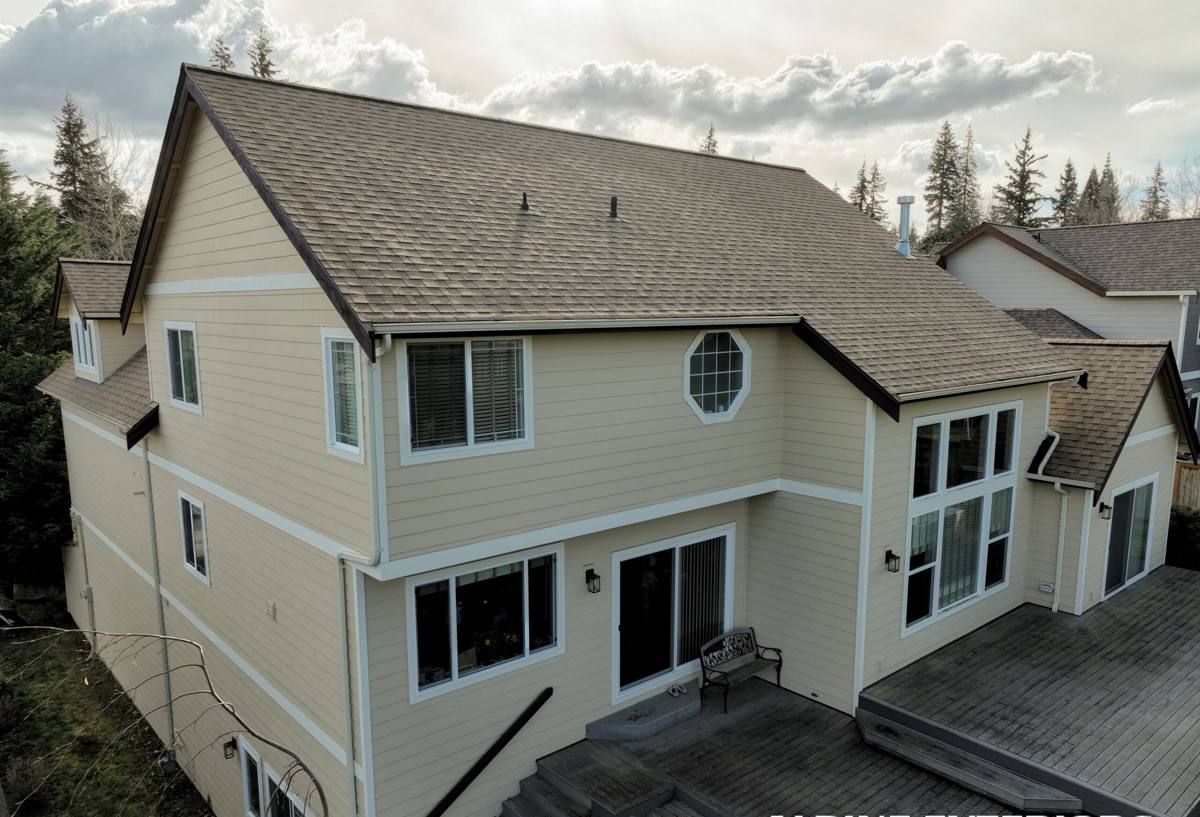
What Salt Air Actually Does to a Roof
Salt air doesn't attack asphalt shingles directly the way it attacks bare metal, but it does accelerate corrosion on every metal component of the roofing system — nails, flashing, vent stacks, drip edge, and any exposed fasteners. In a standard asphalt shingle roof, the fasteners are the weak point: if they corrode and lose holding strength, shingles can lift in wind long before the shingles themselves are worn out. This is why the flashing and fastener grade we use on West Seattle roofs matters more than it would on a comparable roof further from the water. Galvanized components that would be fine inland benefit from a heavier coating or a stainless upgrade at key points — valleys, chimney flashing, and any metal exposed to direct weather — because that's where salt exposure and moisture combine to do the most damage over time.
Where Salt Exposure Shows Up First
- Nail heads and exposed fastener lines developing rust streaks that bleed onto the shingle surface
- Valley metal and step flashing corroding faster than the field of the roof
- Vent stack boots and pipe collars cracking or corroding ahead of schedule
- Gutter hangers and fascia-mounted hardware showing wear before the shingles do
Driving Rain and the Details That Actually Keep Water Out
Most roof leaks in this region don't come from water sitting on open shingle field — they come from wind-driven rain finding its way sideways and upward at transitions: where a roof meets a wall, where a chimney or skylight interrupts the shingle field, in valleys where two roof planes meet, and around any pipe or vent penetration. A well-built shingle roof anticipates that water will be pushed uphill by wind at some point in its life and layers materials so that even then, water has nowhere to go but back off the roof.
That means synthetic underlayment installed correctly with proper overlap, self-adhered waterproof membrane at valleys and eaves where ice and wind-driven rain are most likely to force water backward, correctly woven or metal-lined valleys rather than shortcuts, and step flashing (not just caulk) at every wall intersection. None of this is unusual roofing practice — it's standard trade knowledge. The difference in a wind-and-rain-heavy neighborhood like West Seattle is that skipping or shortcutting any one of these details shows up as an active leak much sooner than it would in a milder location.
| Roof Detail | Why It Matters More Here |
|---|---|
| Underlayment type & overlap | Extended wet periods mean any gap has more opportunity to let water through before it dries |
| Valley construction | Wind-driven rain concentrates at valleys; a weak valley is the most common leak point we find |
| Fastener material | Salt air accelerates corrosion, which weakens wind resistance over time |
| Ventilation balance | Trapped moisture in a damp climate promotes rot and mold in the deck and attic framing |
| Flashing at penetrations | Every pipe, vent, and chimney is a potential entry point once sealant ages and shrinks |
Moss: The Slow Damage Most Homeowners Underestimate
West Seattle's tree cover, moisture, and long shaded season in the cooler months create ideal conditions for moss on north- and west-facing roof slopes, and on any section that stays shaded for a large part of the day. Moss doesn't just look bad. As it grows, it lifts shingle edges, holds moisture directly against the shingle surface far longer than open air would, and works its root structure into the granule layer. Left long enough, moss growth can shorten a shingle roof's usable life by years, independent of how well the roof was installed. It also tends to travel — moss spores spread easily to nearby roof sections and to neighboring properties with a shared tree line.
The fix isn't a one-time power wash. Pressure washing an asphalt shingle roof can strip protective granules and do more harm than the moss itself. The right approach is soft washing or manual removal timed to avoid damaging the shingle surface, paired with zinc or copper strips at the ridge that release trace metal ions with every rain and suppress regrowth over time, and keeping overhanging branches trimmed back so the roof gets more light and air movement. None of this eliminates moss risk in a climate like this one, but it keeps it from becoming a structural issue.
Choosing the Right Shingle for This Climate
Not every asphalt shingle product is built the same way, and the differences matter more in a wet, shaded, salt-exposed neighborhood than they would in a dry climate. We look at a few specific ratings when we're speccing a shingle for a West Seattle home:
| Shingle Feature | Why It Matters for West Seattle |
|---|---|
| Algae-resistant (AR) granules | Slows the black streaking and biological growth common on shaded, damp roof slopes |
| Wind resistance rating | Storms off the Sound bring gusts that test fastener and seal-strip performance |
| Sealant strip quality | A stronger factory seal resists wind uplift better through repeated wet-dry cycles |
| Warranty structure | Algae and moss-related warranty terms vary significantly between manufacturers |
| Shingle thickness/class | Heavier architectural shingles generally shed wind-driven rain better than 3-tab |
We don't push homeowners toward the most expensive option by default. A well-installed mid-tier architectural shingle with algae resistance and a solid wind rating outperforms a premium product installed with weak underlayment or flashing. Installation quality and material selection both matter, but installation quality is what actually determines whether the warranty means anything in practice.
How Our Process Works
Every asphalt shingle project in West Seattle starts with an on-site look at the actual roof, not a generic quote based on square footage alone. That matters because two roofs of the same size can need very different scopes depending on slope, tree cover, existing moss damage, and how the current flashing was done.
- Inspection and assessment. We check the shingle field, flashing, valleys, ventilation, and decking condition, and we look specifically for moss damage and salt-related corrosion on metal components.
- Written scope and options. You get a clear breakdown of what's needed versus what's optional, with shingle options that fit the home and the budget — no pressure toward a specific brand.
- Deck evaluation during tear-off. Any soft, rotted, or delaminated decking found once the old roof comes off gets flagged and priced before it's covered up, not discovered after the fact.
- Underlayment and flashing installation. This is where most long-term performance is decided — valleys, wall transitions, and penetrations all get built to handle wind-driven rain, not just standard rainfall.
- Shingle installation. Correct nailing pattern, exposure, and fastener count per the manufacturer's wind-rated installation instructions, which is also usually what keeps the warranty valid.
- Ventilation check. We confirm intake and exhaust venting are balanced so moisture generated inside the home has somewhere to go instead of collecting in the attic.
- Final walkthrough. We go over the finished roof, cleanup, and any warranty paperwork with you directly.
Signs Your West Seattle Roof Needs Attention
A shingle roof rarely fails all at once. It usually gives warning signs for months or years before a leak actually shows up inside the house. Homeowners who catch these early save significantly on repair scope:
- Dark green or black moss buildup, especially on shaded or north-facing slopes
- Granules collecting in gutters or at the base of downspouts
- Curling, cupping, or lifted shingle edges, particularly after a windy storm
- Rust streaking near flashing, vent boots, or exposed fasteners
- Soft or spongy spots when walked, which often indicate deck damage underneath
- Daylight visible through the roof deck from inside an unfinished attic
- Interior ceiling stains, especially near chimneys, skylights, or exterior walls
Repair, Partial Replacement, or Full Re-Roof?
Not every roofing problem in West Seattle calls for a full tear-off. If the deck is sound and the damage is isolated — a single storm-damaged section, a failed valley, a leak around one penetration — targeted repair is usually the right call, and we'll say so plainly rather than upselling a full replacement. Full replacement makes sense when the shingles are broadly at the end of their service life, when moss or moisture damage has spread across multiple roof planes, or when the underlying decking has enough soft spots that patching around them stops making financial sense. We'll walk you through which category your roof falls into before any work starts, with the reasoning laid out, not just a number.
Maintenance That Actually Extends Roof Life Here
Given how much longer roofs stay wet and shaded in this part of King County compared to drier regions, a short annual maintenance routine goes further here than almost anywhere else in the state:
- Clear gutters and downspouts each fall before the wet season peaks, so water isn't backing up under the shingle edge
- Trim back tree limbs that shade roof sections or drop debris that traps moisture
- Have moss growth addressed early with soft washing rather than letting it establish
- Check and refresh zinc or copper strips at the ridge periodically, since their effectiveness fades over time
- Schedule a walk-through inspection after any significant windstorm off the Sound
Why a Crew That Already Works West Seattle Matters
Roofing crews that work broadly across King County without a specific base of experience in waterfront-adjacent neighborhoods sometimes miss the details that matter most here — the extra attention to flashing metal grade, the moss-prevention step that gets treated as optional elsewhere, the ventilation balance that accounts for a wetter climate. A crew that regularly works West Seattle roofs has already seen how salt air, wind-driven rain, and moss interact on homes with the same exposure as yours, and builds for it by default rather than as an upgrade. That local pattern recognition is often the difference between a roof that needs attention again in eight years and one that holds up for its full expected service life.
If you're dealing with visible moss, a roof that's due for replacement, or you just want an honest read on where your current roof stands, we're happy to take a look. Reach out for a free, no-pressure estimate using the form below.