 Seattle
 Why Renton Roofs Take a Different Kind of Beating
Renton sits at the south end of Lake Washington, in the part of King County where weather systems rolling in off Puget Sound collide with the lowland terrain. That combination brings three things every roof here eventually has to deal with: salt-tinged marine air, wind-driven rain that gets pushed sideways under flashing and shingle edges instead of just falling straight down, and a moss season that runs far longer than most homeowners expect. None of these is dramatic on its own. Together, over years, they wear down roofing systems faster than the same materials would wear in a drier inland climate.
Storm damage repair in Renton is rarely about one catastrophic event. More often it's a windstorm or a heavy atmospheric river event that finishes off a weak spot moss and moisture had already been working on for a season or two. Understanding that combination is the difference between a repair that actually holds and one that fails again in the next storm.
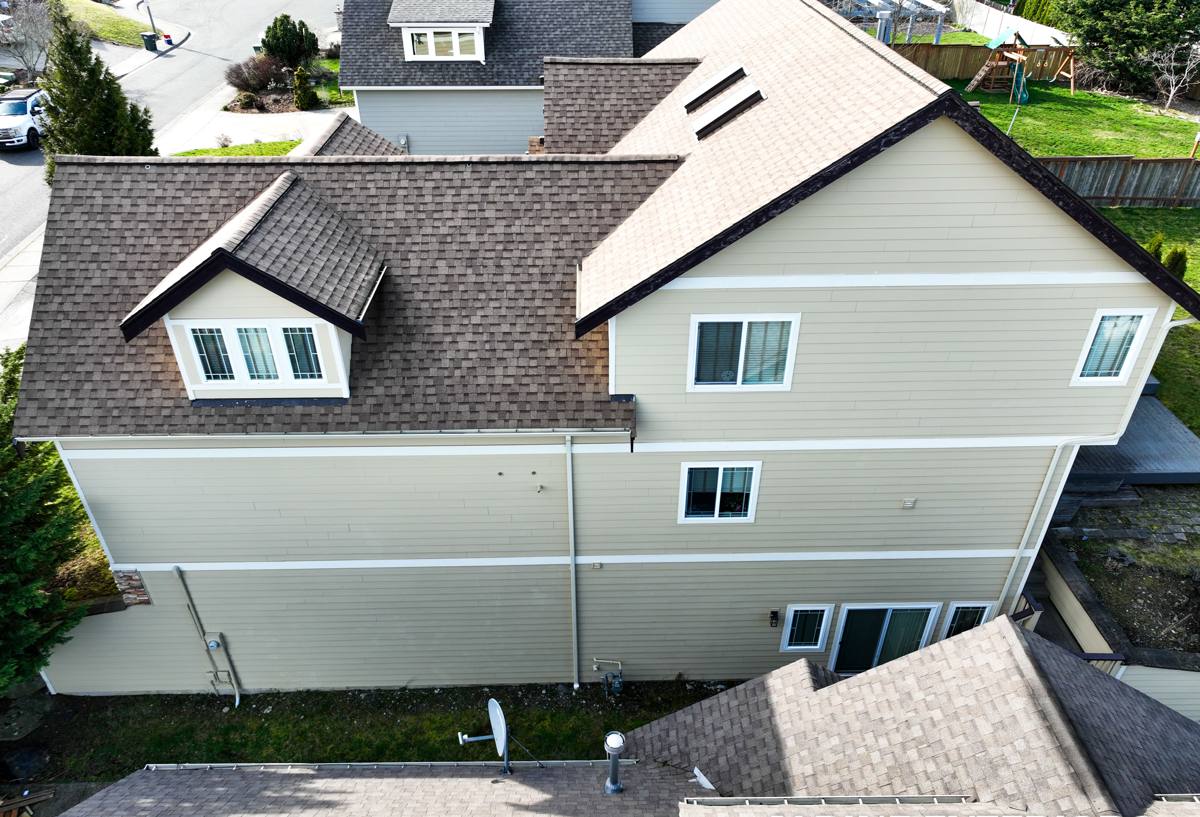
What Storm Damage Actually Looks Like on a Puget Sound-Area Roof
Homeowners often expect storm damage to be obvious — a missing patch of shingles, a visible hole. Sometimes it is. But a lot of storm damage in this region is subtle at first and only becomes a real problem once water has had weeks or months to work its way into the deck and framing underneath.
- Shingles that are lifted, curled, or creased but still technically "in place" — a sign wind has broken the seal without tearing the shingle off
- Granule loss showing up in gutters or at downspout outlets after a storm
- Flashing around chimneys, vents, and skylights that has been bent, pulled loose, or had its sealant cracked by wind flex
- Soft or spongy spots on the roof deck, usually found from the attic side as staining or sagging sheathing
- New or worsening moss growth concentrated where wind has stripped protective granules or where debris has piled up and held moisture
- Water stains on interior ceilings or walls that appear or spread after a specific storm event
- Damaged or dented gutters, downspouts, and roof vents from wind-driven debris
Any one of these on its own might not be urgent. Several together, especially after a named windstorm or a stretch of heavy rain, mean the roof needs a real inspection before the next system moves through.
What a Correct Storm Damage Repair Involves
A repair that's done right addresses the damage itself and the conditions that made it worse. That means more than swapping out a few visibly missing shingles.
Deck and Structure First
Before any new roofing material goes down, the deck underneath has to be checked. If wind or water intrusion has soaked the sheathing, that wood has to be dried out or replaced — covering wet decking with new shingles just traps the problem and guarantees a repeat repair within a year or two.
Underlayment and Water Barriers
Given how much driving rain this region sees, the underlayment layer matters as much as the visible shingles. Self-adhered ice-and-water barrier at eaves, valleys, and around penetrations gives a second line of defense when wind pushes rain up and under the shingle edge — which is exactly the mechanism that causes most storm-related leaks here, as opposed to straight-down rainfall.
Flashing Done Properly
Flashing failure is one of the most common root causes of a "mystery leak" after a storm. Repairs need to re-seat or replace bent flashing, not just re-caulk over it. Caulk is a short-term patch; correctly lapped and fastened flashing is the actual fix.
Matching and Blending
Where only a section of roof is damaged, we match shingle type, color, and exposure as closely as the existing roof allows. On older roofs where the original product has weathered or is no longer available in the same shade, we'll tell you honestly whether a patch will blend or whether a larger section — sometimes a full slope — makes more sense visually and structurally.
Repair or Replace? How We Help You Decide
Not every storm-damaged roof needs full replacement, and not every roof that looks fine after a storm actually is fine. The right call depends on the roof's age, the extent of damage, and what's happening underneath the surface.
| Factor | Repair Usually Makes Sense | Replacement Usually Makes Sense |
|---|---|---|
| Roof age | Under roughly 12-15 years, especially with good maintenance history | Nearing or past the manufacturer's expected service life |
| Extent of damage | Isolated to one section, slope, or a handful of penetrations | Spread across multiple slopes or found alongside widespread granule loss |
| Deck condition | Sheathing is dry and sound once opened up | Rot or soft spots found in multiple areas |
| Moss/algae history | Light, surface-level growth with no material breakdown underneath | Long-term moss growth that's already degraded shingles or decking |
| Insurance scope | Adjuster's scope aligns with a targeted repair | Adjuster approves full slope or full roof replacement |
We inspect first and give you a straight answer — including telling you when a repair is genuinely the right call, even though a full replacement is a bigger job for us. A roof that only needs a repair doesn't need to be sold a replacement.
How Our Process Works
- Initial assessment. We inspect the roof, attic, flashing, and gutters to document the full extent of storm damage, not just what's visible from the ground.
- Emergency mitigation, if needed. If there's active leaking or exposed decking, we get the roof temporarily protected — tarping and securing loose material — before scheduling permanent repairs.
- Documentation for your records. We provide clear photos and a written scope of the damage found, which you can use for your own insurance claim conversations.
- Repair plan and honest scope. You get a plain-English explanation of what needs fixing, what it involves, and why — no padded scope, no upsell to a full replacement you don't need.
- The repair itself. Deck repair or replacement where needed, new underlayment and flashing at vulnerable points, and matched roofing material installed to manufacturer specification.
- Cleanup and final check. Site cleaned, gutters cleared of storm debris, and a final walkthrough so you know exactly what was done.
Insurance Claims: What Renton Homeowners Should Know
Storm damage claims are common enough in King County that most insurers have a process for them, but that doesn't mean the process is simple. A few things worth knowing:
- Adjusters often scope only what's visible from the ground or a quick walk of the roof — a contractor's more thorough inspection can surface additional legitimate damage they missed
- Timing matters. Many policies have windows for filing after a specific storm event, so documenting damage promptly is worth doing even if you're not ready to start repairs immediately
- We're happy to meet an adjuster on-site and walk the roof with them, but we work for you, not the insurance company — our job is an honest assessment, not inflating or minimizing a claim
- Not all storm damage is covered the same way; wear-and-tear that a storm simply exposed (like long-term moss damage) is treated differently by most policies than acute wind or impact damage
Moss, Mold, and What Happens After the Repair
A storm repair that ignores moss is a repair that will need to be revisited. Renton's mix of shade, moisture, and mild temperatures year-round is close to ideal moss-growing conditions, and moss holds water against the roofing material far longer than open air ever would. That trapped moisture is what turns small storm damage into decking rot over a season or two.
As part of storm repair work, we'll flag areas where moss is established and talk through practical prevention — keeping gutters and valleys clear, addressing overhanging branches that shade the roof, and where appropriate, zinc or copper control strips that discourage regrowth without harsh chemical treatments that can shorten shingle life.
Why a Crew That Already Works in Renton Matters
After a significant windstorm, it's common to see traveling crews going door to door in affected neighborhoods offering fast, cheap repairs. Some of that work is fine. A lot of it isn't — repairs done without proper flashing detail or underlayment that fail again in the next storm, sometimes before the crew has even left town.
Working Renton and the surrounding King County area regularly means we're familiar with how local building conditions — tree cover, roof pitches common in the area's housing stock, and the specific way storms move through this part of the Puget Sound lowlands — affect what actually needs to be done. It also means we're still here next season if a repair needs a warranty follow-up, which is worth more than a lower bid from a crew that won't be back.
Get a Free, No-Pressure Estimate
If a recent storm has left you with missing shingles, a leak, or just an uneasy feeling about your roof, it's worth having it looked at before the next system rolls through. We'll give you a straightforward assessment of what's actually going on and what it would take to fix it right — no pressure, no inflated scope. Use the form below to request a free estimate for your Renton home.