 Seattle
 Why Composite Decking Makes Sense Around Green Lake
Homes near Green Lake sit under some of the heaviest tree canopy in Seattle. That canopy is part of what makes the neighborhood desirable, but it also means decks here spend most of the year in dappled shade, catching leaf litter, and staying damp longer after a storm than a deck out in the open would. Add in Puget Sound's salt-tinged marine air drifting through the region and the long stretch of driving rain that defines a King County winter, and you have a climate that is genuinely hard on outdoor wood surfaces.
Composite decking was built to handle exactly this kind of exposure. A correctly installed composite deck resists rot, doesn't need annual staining, and holds up to the freeze-thaw swings and moss pressure that wear down a traditional wood deck within a decade. That said, "composite" is not a single product, and a deck is only as good as the framing, flashing, and fastening underneath the boards. That's where a lot of decks in this area actually fail — not the boards themselves, but everything hidden below them.
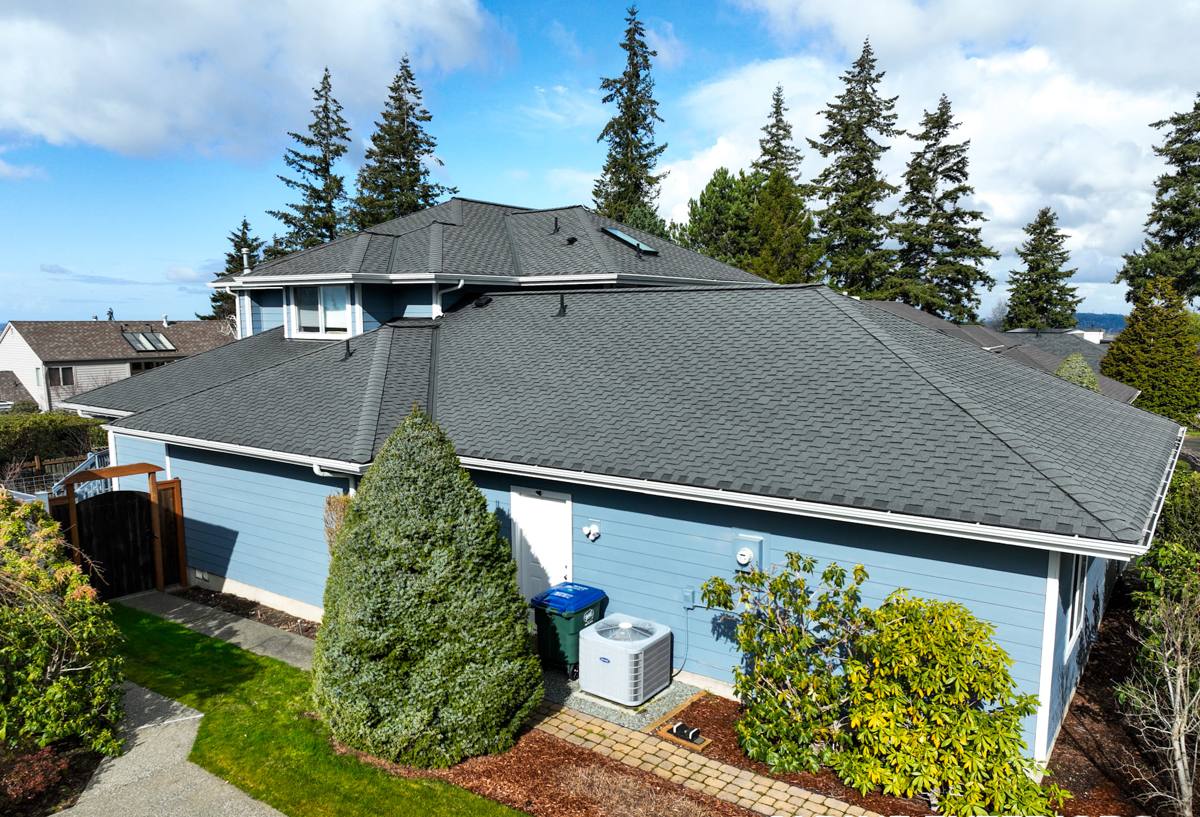
What Green Lake's Climate Actually Does to a Deck
Moss and Organic Buildup
Shade from mature trees keeps deck surfaces from drying out between rains for much of the fall through spring. That moisture, combined with leaf and needle litter collecting in board gaps, is exactly what moss and algae need to take hold. On a wood deck, moss traps moisture against the fibers and accelerates rot. On composite, the concern is different — moss and algae can grow on the surface film of some boards, making them slick, though the board material itself isn't being eaten away.
Driving Rain and Standing Water
Seattle's winter rain tends to come sideways more than straight down, which means water gets pushed against ledger boards, railing posts, and any exposed end grain. If a deck's flashing, slope, or drainage wasn't done right the first time, that water finds its way into the framing rather than off the edge of the deck.
Salt Air and Hardware Corrosion
Homes closer to Puget Sound's salt-carried air see faster corrosion on unprotected fasteners, brackets, and railing hardware than homes further inland. Even at Green Lake's distance from the water, it's common enough that we spec corrosion-resistant hardware on every deck we build in this region rather than treating it as an upgrade.
Freeze-Thaw Cycling
King County doesn't get deep winters, but it does get repeated freeze-thaw swings — cold snaps followed by rain and a thaw. Water that's worked its way into a joint or a poorly sealed post base expands and contracts with those cycles, which is how small gaps in the original construction turn into real structural problems over several years.
Composite vs. Wood vs. PVC: What's Actually Different
Every decking material has real trade-offs. Here's how the common options actually compare for a shaded, wet climate like this one — not marketing claims, just how they behave over time.
| Material | Moisture Behavior | Moss/Algae Resistance | Maintenance | Typical Lifespan Here |
|---|---|---|---|---|
| Pressure-treated wood | Absorbs water, prone to cupping and splitting | Low — moss takes hold easily in shade | Annual cleaning, periodic staining/sealing | 10-15 years before major repairs |
| Cedar | Naturally rot-resistant but still absorbs moisture | Moderate | Regular sealing to hold color and resist rot | 15-20 years with upkeep |
| Capped composite | Core resists moisture; capped shell blocks absorption | Higher — surface can be cleaned off, doesn't feed rot | Periodic washing, no staining or sealing | 25-30+ years |
| PVC/cellular decking | Fully synthetic, no organic core to rot | Highest — nothing for moisture to soak into | Lowest — occasional washing | 25-30+ years |
We steer most Green Lake homeowners toward capped composite rather than early-generation uncapped composite. Uncapped boards still have an exposed wood-fiber surface that can absorb moisture and stain, which defeats a lot of the point in a climate this wet. The capped shell is what actually holds up to the moss-and-rain cycle year after year.
What a Correctly Built Composite Deck Actually Involves
The boards are the visible part of the job, but most of what determines whether a composite deck lasts is underneath them:
- Ledger flashing — a proper metal or membrane flashing where the deck meets the house, so wind-driven rain can't work its way behind the siding.
- Joist tape — a protective membrane over the top of every joist, since composite boards trap moisture against the framing more than open wood does.
- Correct slope — a slight pitch away from the house so water sheets off rather than pooling.
- Hidden fastening systems — clips rather than face screws, both for appearance and to avoid creating hundreds of small penetration points where water can enter a board.
- Ventilation underneath — enough clearance and airflow below the deck that moisture and moss debris don't just sit and accumulate.
- Corrosion-resistant hardware — brackets, screws, and post hardware rated for coastal and wet-climate exposure.
- Board spacing — small, consistent gaps that account for material expansion and let debris and water pass through instead of collecting.
Skip any one of these and the boards themselves can be perfectly good product and the deck will still fail early — usually with hidden rot in the framing well before the composite surface shows any wear.
Our Process, Start to Finish
- On-site assessment — we look at the existing structure (if there is one), grading, drainage path, sun/shade exposure, and how the deck ties into the house.
- Design and material selection — board tier, color, railing style, and layout based on your budget and how you actually use the space.
- Permitting — we handle the permit application and inspection scheduling with the local jurisdiction so you're not the one navigating that process.
- Demo and framing — removal of the old deck if applicable, then framing built or reinforced to current code, with flashing and joist protection installed before a single board goes down.
- Decking and railing installation — boards fastened with a hidden clip system, railings and stairs built to code for guard height and baluster spacing.
- Final walkthrough — we go over the finished deck with you, including what maintenance it actually needs (and what it doesn't).
What Drives Cost on a Green Lake Composite Deck
We don't post fixed prices because every lot and every existing structure is different, but these are the factors that actually move the number:
| Factor | Why It Matters |
|---|---|
| Deck size and shape | More square footage and more corners/cutouts both add material and labor time |
| Condition of existing framing | Reusable framing lowers cost; rot or undersized joists mean a rebuild |
| Height and multi-level design | Elevated or multi-tier decks require more structural engineering and railing code work |
| Board tier | Entry-level capped composite vs. premium PVC or high-end composite lines carries a real price spread |
| Railing style | Composite or aluminum railing systems cost more than basic wood but need far less upkeep |
| Site access | Tight lots, mature landscaping, or limited equipment access around the tree canopy common near the lake can add labor time |
| Permit requirements | Height, attachment to the house, and guard/stair code compliance all factor into permit scope |
Maintenance Composite Decking Actually Needs Here
One of the real advantages of composite is how little upkeep it needs compared to wood — but "low maintenance" isn't "no maintenance," especially with a long moss season working against you. A realistic annual routine:
- Sweep leaves and needles out of board gaps before they compost in place, especially in fall
- Wash the surface once or twice a year with a soft-bristle brush and a composite-safe cleaner to remove algae film before it builds up
- Rinse under-deck framing and joist areas periodically if debris tends to collect there
- Check railing posts and fastener points for looseness after winter storms
- Keep gutters and downspouts near the deck clear so runoff isn't dumping directly onto the deck surface
- Trim back overhanging branches where practical to reduce shade and debris buildup on the deck itself
Why Hiring a Crew That Already Works This Neighborhood Matters
A deck built for a sunny, open lot in eastern Washington and a deck built for a shaded, tree-covered lot near Green Lake shouldn't be built the same way, even with identical materials. Crews who work this area regularly already account for the drainage planning that heavier clay-content soils common around Seattle demand, the permit process through the city, and the moss and shade realities that a one-size-fits-all deck spec ignores. That familiarity shows up in decisions you might not think to ask about — board spacing tuned for wetter conditions, extra attention to under-deck airflow, hardware chosen for this specific corrosion environment — rather than a generic install that looks the same everywhere.
It also matters for accountability. A contractor who works Green Lake and the surrounding King County area regularly has a reputation to protect with neighbors, not just a single job to finish and move on from.
If you're considering a new composite deck or replacing an aging one near Green Lake, we're happy to walk the site with you and give you a straightforward, no-pressure estimate — just fill out the form below.