 Seattle
 Composite Decking Built for Bellevue's Wet Eastside Climate
Bellevue sits back from Puget Sound, but it doesn't escape the weather pattern that defines this whole corner of Washington: long stretches of damp air, driving rain for months at a time, and short windows for anything outdoors to actually dry out. A deck here spends more of the year wet than dry. That's the reason composite decking has become the default choice for homeowners who are tired of refinishing wood every year or two, and it's also why a composite deck installed the wrong way can still fail early — the material is more forgiving than wood, but it isn't forgiving of bad drainage, poor ventilation, or shortcuts in the substructure.
This page covers what we look at specifically for Bellevue properties — the shade from mature landscaping, the moss and algae pressure that builds up over a wet winter, and the framing details that keep a deck performing for decades instead of just looking good for the first few years.
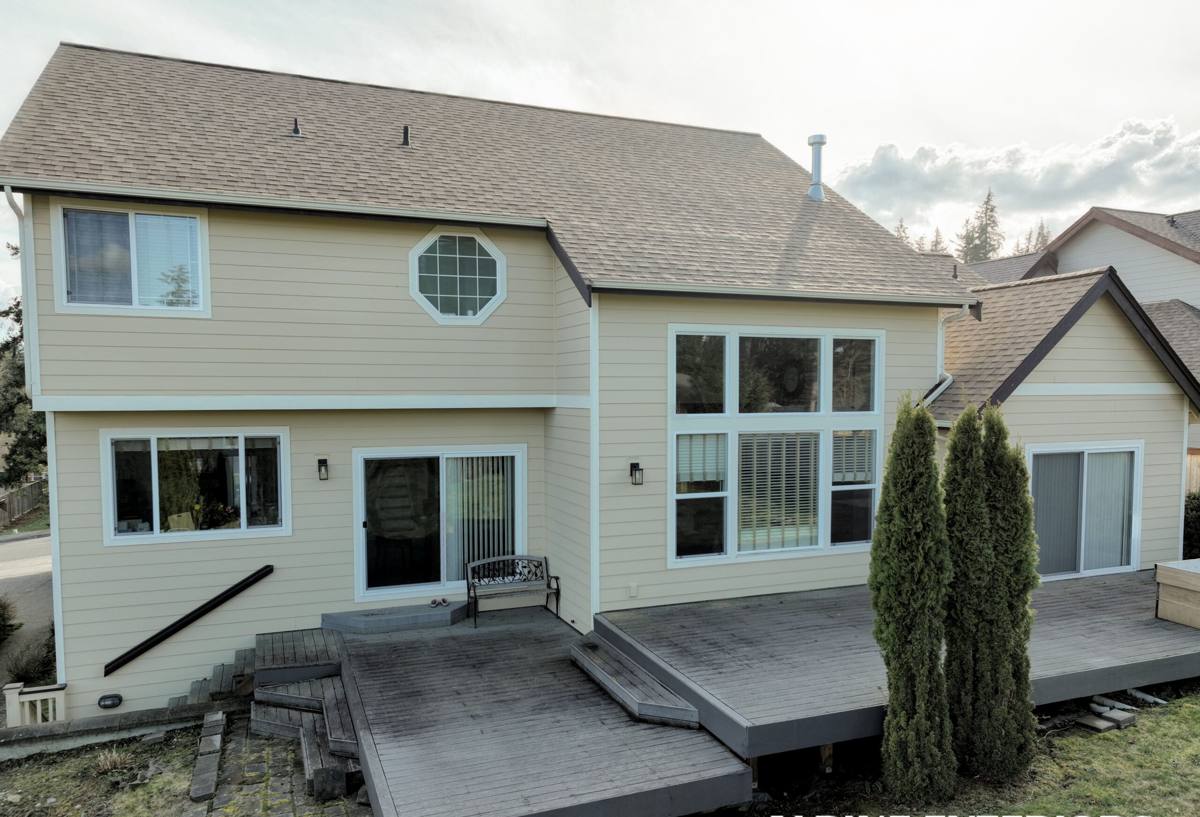
What the Local Climate Actually Does to a Deck Over Time
Moisture that doesn't leave
King County's rainy season isn't just about total rainfall — it's the number of consecutive damp days where surfaces never fully dry between storms. On a deck, that means end grain, fastener holes, and the underside of boards stay wet longer than most manufacturers assume in their installation guidelines written for drier climates.
Shade and tree cover
A lot of Bellevue lots have mature trees or dense landscaping close to the house, which is great for privacy but keeps decks shaded and slow to dry. Shaded, damp wood surfaces are exactly where moss, algae, and mildew take hold fastest, and organic buildup on any decking material — composite included — becomes a slip hazard if it's not addressed.
Freeze-thaw swings
The Eastside doesn't get deep winters, but it does get repeated freeze-thaw cycles — cold snaps followed by rain and a quick thaw. That cycle is hard on any fastener, flashing seam, or ledger connection that wasn't detailed correctly, because trapped moisture expands and contracts against the same joint over and over.
Composite vs. Wood Decking: What Actually Holds Up Here
We install both, and there are still cases where a homeowner has a good reason to choose wood. But for most Bellevue properties, especially anything shaded or close to mature trees, composite is the lower-maintenance, longer-term choice. Here's the honest comparison:
| Factor | Composite Decking | Pressure-Treated Wood |
|---|---|---|
| Moisture resistance | Capped boards shed water and resist rot; won't splinter or cup from repeated wetting | Absorbs moisture in a wet climate faster than it dries; prone to warping and checking |
| Moss and algae | Still needs periodic cleaning, but the surface doesn't feed organic growth the way raw wood fibers do | Rougher grain holds moisture and organic buildup, especially in shaded areas |
| Annual maintenance | Occasional wash-down; no staining or sealing | Needs re-staining or sealing every 1-2 years in this climate to hold up |
| Upfront cost | Higher material cost | Lower material cost |
| Long-term cost | Lower over 15-20 years once maintenance labor is factored in | Lower material cost is often offset by recurring maintenance and earlier board replacement |
| Warranty structure | Manufacturer warranties typically cover material defects and fading for 25+ years when installed to spec | Warranty coverage is usually limited to the lumber itself, not workmanship |
The trade-off that matters most: composite only delivers on that longer lifespan if the substructure underneath it is built correctly. A composite deck laid over an undersized or poorly ventilated frame will still trap moisture and cause problems — just underneath the boards instead of on top of them.
What a Correct Composite Deck Installation Involves
Framing and joist spacing
Composite boards flex differently than wood, and manufacturers publish specific joist spacing requirements — often tighter than what's standard for a wood deck, especially at angles, stairs, and picture-frame borders. Following those specs isn't optional if you want the warranty to be valid, and it's also what prevents the bounce and soft spots that show up a few years in when spacing was stretched to save material.
Fastener systems
Hidden fastener clips are standard on most composite installs now, and for good reason: face screws create a puncture point where water can sit against the board core. Clip systems keep the board surface intact and give a cleaner look, but they need to be installed with the correct gap tolerance so the boards can expand and contract with temperature and moisture changes without buckling.
Flashing at the house
Every deck ledger board attaches to the house, and that connection is the single most common source of hidden rot on any deck — wood or composite. Proper flashing (and keeping the ledger separated from the house sheathing with the right gap and membrane) matters more in a climate where the ledger is going to see rain-driven moisture for months at a stretch, not just a few storms a year.
Drainage and Ventilation: The Details That Matter in This Climate
A lot of deck problems we get called out to inspect aren't visible from the top — they're happening underneath, where nobody looks until there's a soft spot or a smell. In a climate with Bellevue's rainfall pattern, three things make the difference between a deck that lasts and one that doesn't:
- Ground clearance and airflow — the space under the deck needs enough clearance and cross-ventilation to actually dry out between storms, not just meet a minimum code number.
- Footing depth and drainage — footings need to be set below frost depth and away from standing water, especially on sloped Eastside lots where runoff concentrates in ways that aren't obvious until after a heavy rain.
- Board gapping and slope — composite boards still need a slight slope away from the house and correct gapping between boards so water sheets off instead of pooling, especially at the base of stairs and against house walls.
Choosing the Right Composite Boards for a Bellevue Property
Not all composite decking is built the same way, and the differences matter more in a wet climate than a dry one.
Capped vs. uncapped composite
Fully capped composite boards have a polymer shell wrapped around the core on all four sides, which is what actually gives them their moisture and stain resistance. Uncapped or partially capped boards cost less but expose more of the wood-fiber core to the weather, and in a climate like ours that shows up as fading, moisture absorption, and mold susceptibility faster than in drier regions.
Grooved vs. solid-edge boards
Grooved-edge boards work with hidden fastener clips and give the cleanest look, but the groove itself can hold a little more moisture and debris than a solid-edge board finished with color-matched screws. Either is a legitimate choice — it's a matter of the look you want and how the fastening system is detailed.
Color and shading
Darker composite colors show pollen, tree debris, and water spotting less than very light colors, which is worth thinking about on a shaded, tree-covered lot. Darker boards also run a little warmer underfoot in direct sun, but that's rarely an issue on shaded Bellevue properties the way it can be on an open, south-facing deck.
How Our Process Works, Start to Finish
We walk every Bellevue property in person before quoting anything — deck problems here are rarely just about the boards, and a quote based on square footage alone misses the drainage and framing issues that actually determine cost and longevity.
- On-site assessment — we look at drainage, shade, existing framing (if it's a tear-off and replace), ledger condition, and slope of the yard.
- Design and material selection — board brand, color, fastener system, railing, and any picture-framing or stair details, matched to your budget and how the space will be used.
- Permit handling — we pull the required permit and schedule inspections so the work is documented and covered, rather than cutting corners that show up later at resale.
- Framing and structural work — footings, ledger flashing, joists spaced to the composite manufacturer's spec, not generic lumber spacing.
- Decking installation — boards, hidden fasteners, picture-framing or borders, stairs, and railing.
- Final walkthrough — we go over the finished deck with you, confirm drainage is working as intended, and explain the manufacturer warranty registration and basic care.
Keeping a Composite Deck Looking Good Through Bellevue Winters
Composite decking is low-maintenance, not no-maintenance. A little seasonal attention goes a long way in this climate:
- Sweep leaves and debris off the deck regularly in fall — trapped organic matter is what feeds moss and algae growth over winter.
- Wash the surface with a soft-bristle brush and a composite-safe cleaner once or twice a year, more often in shaded areas.
- Keep gutters and downspouts near the deck clear so runoff isn't draining directly onto or under the decking.
- Check that furniture feet, planters, and grills aren't blocking board gaps or drainage paths.
- Avoid pressure washing at close range or high PSI directly into board seams — it can force water past the cap layer at fastener points.
- Have railings, stairs, and ledger connections looked at every couple of years, since those are the spots where hidden problems tend to start.
Why Hire a Crew That Already Works in Bellevue
Building codes, permit requirements, and inspection timelines vary by jurisdiction across King County, and a crew that works Bellevue regularly already knows what the local building department expects on setbacks, guard height, and footing depth — which means fewer delays and no surprises at inspection. Local experience also means knowing which fastener systems and board brands have actually held up on Eastside homes over years of real weather, not just what a manufacturer's spec sheet claims. That's the difference between a deck that's built to a general standard and one that's built for the conditions it will actually sit in.
If you're weighing composite decking for a home in Bellevue, we're happy to walk the property, look at drainage and shade conditions specific to your lot, and put together a straightforward, no-pressure estimate — just fill out the form below.