 Seattle
 Why Wallingford Decks Wear Out Faster Than Homeowners Expect
Wallingford is one of Seattle's older, more established residential neighborhoods, and that means a lot of the decks we get called out to inspect are original to homes built decades ago, or were added on in an era when deck-building code and materials were a lot less rigorous than they are today. Combine that with King County's climate — long stretches of driving rain, damp marine air moving in off Puget Sound, and heavy tree cover that keeps yards shaded and slow to dry — and you get conditions that are genuinely hard on exterior wood structures.
Moss is the most visible symptom. A north-facing deck tucked under mature trees can stay damp for days after a storm, and moss doesn't just look bad — it holds moisture directly against the decking boards and framing underneath, which accelerates rot from the top down. Salt-laden air is a slower, quieter problem: it speeds up corrosion on fasteners, joist hangers, and any exposed metal hardware, which is often the actual reason a deck that "looks fine" on top turns out to be unsafe underneath.
None of this means a deck can't last in this climate — it means it has to be built for this climate, not just built to a generic set of plans.
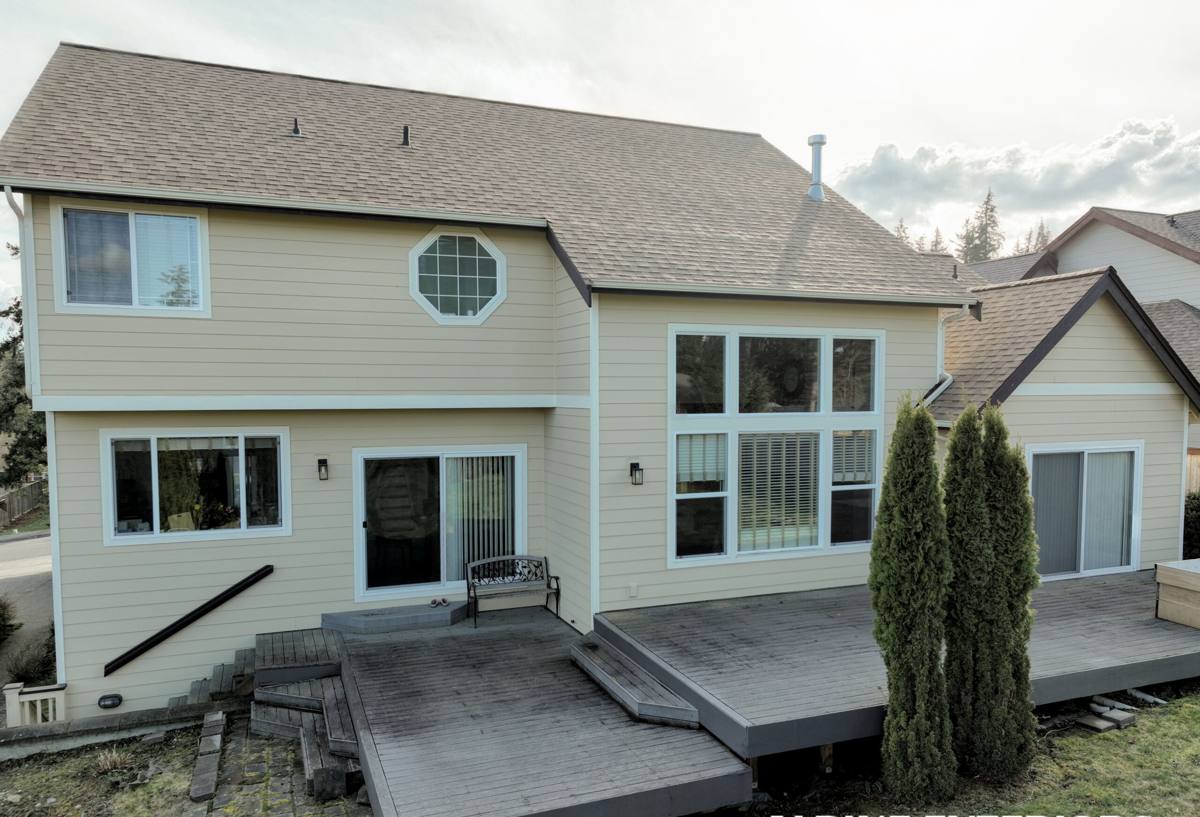
Repair or Replace? Signs It's Time for a Full Rebuild
Not every tired deck needs to come out. But there's a point where patching individual boards stops being a real fix and starts being a way to delay a bigger problem. We look for a combination of the following before recommending full replacement:
- Soft, spongy, or springy spots when you walk across the deck surface
- Visible rot, splitting, or delamination at the ledger board where the deck attaches to the house
- Rust staining or corrosion around joist hangers, bolts, or post bases
- Persistent moss or algae growth that comes back within weeks of cleaning
- Wobble or movement in the railing posts when pushed by hand
- A deck built without proper flashing at the house connection (common on older additions)
- Multiple structural repairs already made over the years with no consistent standard
If a deck has one or two of these issues isolated to a small area, targeted repair can make sense. When several show up together, especially anything involving the ledger connection or joist hangers, that's usually a sign the structure has been compromised long enough that a full rebuild is the more honest recommendation — both for safety and for your long-term cost.
What a Correct Deck Replacement Actually Involves
A deck replacement done right is a structural project, not a cosmetic one. The decking boards you walk on are the last thing installed, not the first thing to think about.
The Ledger and Flashing Connection
This is where the deck attaches to your house, and it's the single most common failure point we find on older Seattle-area decks. A ledger board without proper flashing lets rainwater track directly behind it and into the house rim joist, which can lead to rot in both the deck framing and the home's structure. Correct installation means step flashing, a water-resistant barrier, and properly spaced fasteners rated for exterior use — every time, no shortcuts.
Framing and Footings
Joist spacing, beam sizing, and post footings all need to match the actual load the deck will carry, not just whatever was done originally. In our climate, we pay close attention to footing depth and drainage so posts aren't sitting in standing water through the winter, and we use corrosion-resistant fasteners and hardware throughout, since standard hardware degrades faster here than it would in a drier climate.
Ventilation and Drainage Underneath
A deck built low to the ground or over poorly graded soil traps moisture underneath, which speeds up rot from below even if the top surface looks fine. Proper grading, gaps for airflow, and keeping vegetation from crowding the underside all matter more here than they would in a drier region.
Choosing the Right Decking Material for Wallingford's Conditions
There's no single "best" decking material — the right choice depends on how much sun and shade your yard gets, how much upkeep you're willing to do, and your budget. Here's how the common options actually compare under King County's wet, moss-prone conditions:
| Material | Moss & Moisture Resistance | Maintenance | Typical Lifespan |
|---|---|---|---|
| Pressure-treated wood | Moderate — needs sealing to perform well | Annual cleaning and periodic re-sealing | 10–15 years with upkeep |
| Cedar | Good natural resistance, but surface still needs care | Regular cleaning, occasional oiling | 15–20 years with upkeep |
| Capped composite | Very good — resists moisture absorption | Occasional washing, no sealing | 25–30 years |
| PVC decking | Excellent — essentially non-porous | Occasional washing | 25–30+ years |
Composite and PVC decking cost more upfront, but in a shaded, damp yard they hold up with far less seasonal maintenance than wood — no annual sealing, and moss has less to grip onto compared with a porous wood surface. Wood costs less initially and has a natural look many homeowners prefer, but it only performs well here if you're genuinely willing to keep up with cleaning and sealing on a schedule. We'll walk through your specific site — sun exposure, tree cover, how the deck will be used — and give you an honest read on which material actually fits, rather than defaulting to whatever has the highest margin.
Our Deck Replacement Process
We keep the process straightforward and communicate clearly at each stage, since a deck rebuild does take over a meaningful part of your yard for a while.
- On-site assessment — we inspect the existing structure, ledger connection, footings, and framing to confirm what's actually driving the need for replacement
- Design and material selection — we talk through layout, railing style, and decking material based on your home, your yard's sun/shade pattern, and your budget
- Permitting — we handle the permit process where required so the work is documented and inspected correctly
- Demolition and disposal — full removal of the old deck, including any hardware and footings that need to be redone
- Framing and flashing — new ledger flashing, joists, beams, and footings built to current code and sized for the actual load
- Decking, railing, and finish work — installation of the chosen decking material, railings, stairs, and any trim or lighting
- Final walkthrough — we review the finished deck with you and confirm everything meets both code and your expectations
Permits and Building Code in Seattle
Most deck replacement work in Seattle requires a permit, particularly when the deck is elevated, attached to the house, or being rebuilt with new footings. Permitted work means the ledger flashing, framing, and railing height all get inspected against current code — which matters both for safety and for resale, since an unpermitted deck can become a real headache when a home eventually goes on the market. We manage this as part of the project so you're not left navigating the King County and City of Seattle permitting process on your own.
Why Hire a Crew That Already Works in Wallingford
A deck replacement anywhere in western Washington needs to account for rain and moisture. But a crew that regularly works Wallingford's older homes has already seen how this specific neighborhood's mix of mature tree canopy, established lot layouts, and older housing stock tends to age. We know what to expect when we pull up an old ledger board on a house from this era, and we know which framing shortcuts were common in older additions that need to be corrected, not repeated.
That familiarity also means fewer surprises mid-project. We're not guessing at how a shaded, tree-covered lot in this part of Seattle will behave through a wet winter — we've built and repaired decks under exactly those conditions before.
Keeping Your New Deck Performing Long-Term
A well-built deck still needs some seasonal attention in this climate, especially in shaded yards:
- Sweep leaves and debris off the deck surface regularly through fall, since trapped organic matter feeds moss growth
- Rinse or wash the surface a couple of times a year to knock back early moss and algae before it takes hold
- Keep gutters and downspouts clear so runoff isn't draining directly onto or under the deck
- For wood decking, plan on resealing on the schedule recommended for your specific product
- Trim back vegetation that's shading the deck or crowding the space underneath, to improve airflow and drying time
A few minutes of upkeep a couple times a year goes a long way toward protecting the investment, regardless of which material you choose.
If your deck is showing its age, or you're just not sure whether it needs repair or a full rebuild, we're happy to take a look and give you a straight answer. Reach out for a free, no-pressure estimate using the form below.