 Seattle
 Why Shoreline's Climate Is Hard on Decks
Shoreline sits close enough to Puget Sound that salt-laden air reaches yards and decks even blocks from the water, and it combines with King County's long wet season to create conditions that are genuinely tough on outdoor building materials. Wood decking here faces three compounding problems: near-constant moisture from driving rain off the Sound, salt air that accelerates corrosion on fasteners and hardware, and a moss and algae season that can run from fall through spring. A deck that would hold up fine in a drier inland climate can show rot, fastener staining, and slick green growth within a few seasons in Shoreline if it wasn't built with this specific combination of exposures in mind.
Composite decking was developed largely to solve these exact problems, but "composite" isn't a single product — it's a category, and how it's installed matters as much as which board you choose. A composite deck installed without proper attention to drainage, airflow, and ventilation underneath will still grow moss, still trap moisture against the substructure, and still fail early, just more slowly than a wood deck would.
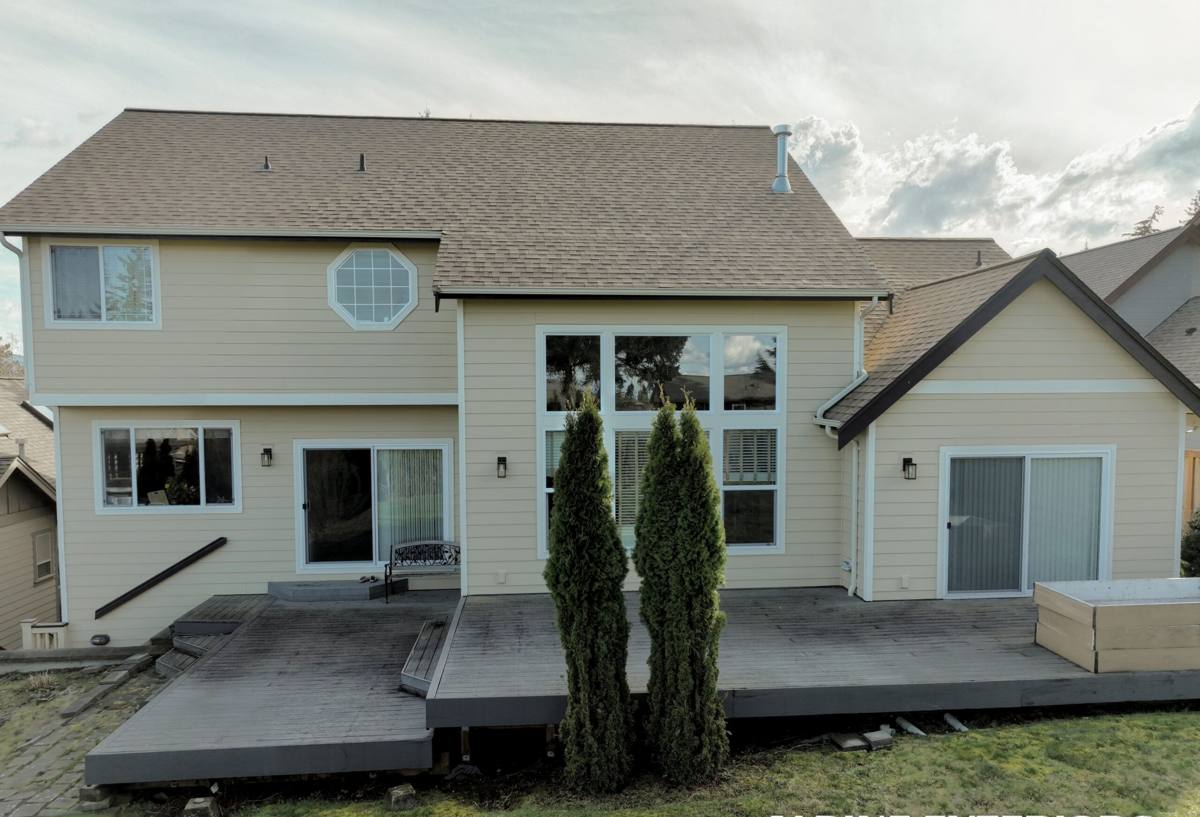
What Composite Decking Needs to Get Right Here
Drainage and Slope
Every deck surface needs a slight slope away from the house so water sheets off instead of pooling. In a climate that gets as much sustained rainfall as this region, even a slight installation error in slope shows up fast — as standing water, algae growth, or staining at board seams. We check and set this slope during framing, not after the boards are down.
Substructure and Ventilation
The framing underneath a composite deck matters more than most homeowners realize. Composite boards themselves resist rot, but the joists, beams, and ledger board underneath are typically still wood (or wood-hybrid), and those need airflow and moisture protection just as much as they would on any other deck. Low-clearance decks close to grade, or decks built tight against siding without a gap, trap the moist air that's common here and give moss and mildew a place to take hold on the substructure even when the surface boards look fine.
Fasteners and Hardware
Salt air corrodes standard hardware faster than most people expect, and corroding fasteners are one of the more common hidden failure points we find on older decks near the Sound. Stainless steel or coated, corrosion-rated fasteners and structural connectors cost more up front but are a straightforward requirement for a deck that's meant to last in this environment — not an upsell.
Ledger Attachment and Flashing
Where the deck attaches to the house is the single most common point of water intrusion on any deck, composite or otherwise. Correct flashing at the ledger board keeps water from working its way behind siding and into the house framing — a detail that's easy to get wrong and expensive to fix later if it's missed.
Composite vs. Other Decking Materials for This Climate
| Material | Moisture Behavior | Moss/Algae Resistance | Maintenance |
|---|---|---|---|
| Capped Composite | Doesn't absorb water into the board itself; core is protected by a cap layer | Resists staining better than wood; still needs periodic cleaning in shaded, damp areas | Occasional washing; no staining or sealing |
| Uncapped Composite | Can absorb some moisture at cut edges and fastener holes over time | More prone to surface staining than capped versions | Low, but less forgiving of installation gaps than capped boards |
| Pressure-Treated Wood | Absorbs and releases moisture constantly; prone to cupping and checking | Grows moss readily in shaded, wet areas without regular treatment | Annual cleaning, periodic staining/sealing |
| Cedar | Naturally moisture-resistant but still absorbs water over time | Better than pressure-treated but still needs upkeep | Regular sealing to maintain appearance and resistance |
We install capped composite for most Shoreline projects because the cap layer — a protective outer shell bonded to the board — is what actually keeps moisture and organic growth from working into the material itself. Uncapped composite and lower-grade boards can still perform reasonably well, but they're more sensitive to installation quality and tend to show their age faster in a climate this wet. We'll talk through the honest trade-offs for your project and budget rather than defaulting to the most expensive option.
Our Process, Start to Finish
We approach every Shoreline composite deck project the same structured way:
- Site assessment — we look at drainage patterns, sun/shade exposure, existing structure condition, and how close the deck sits to grade or to the house, since these all affect moss risk and framing decisions.
- Structural evaluation — if we're replacing an existing deck, we check the ledger, footings, and framing for hidden rot or corrosion before quoting the job, since deck failures usually start below the surface, not on top of it.
- Design and material selection — board pattern, color, railing style, and fastener system, matched to your home and to what actually holds up in this climate.
- Permitting — most deck projects in Shoreline require a building permit, particularly for structural work, elevated decks, or new footings; we handle this as part of the project rather than leaving it to the homeowner.
- Build — framing first, with correct slope, ventilation gaps, flashing, and corrosion-rated hardware, then decking, then railings and finish details.
- Walkthrough — we go over the finished deck with you, including what maintenance (if any) it actually needs going forward.
Moss, Algae, and Everyday Maintenance
Composite decking doesn't need staining or sealing, but "low-maintenance" doesn't mean "no maintenance," especially in a climate with a moss season as long as this region's. Shaded areas of a deck, spots that don't get much airflow, and areas under furniture or planters are the most likely to develop surface growth over a wet winter. The fix is usually simple — a periodic wash with a soft-bristle brush and a composite-safe cleaner, and keeping debris (leaves, needles, dirt) from building up in board gaps where moisture collects. What actually prevents the problem long-term is the installation itself: proper board spacing, slope, and airflow underneath mean less standing moisture in the first place, which means less to clean.
- Rinse or sweep debris out of board gaps before it compacts, especially going into fall
- Move planters and furniture periodically so shaded spots don't stay damp continuously
- Wash shaded or north-facing sections more often than sun-exposed areas
- Check railing posts and stair stringers yearly for hardware corrosion
- Keep gutters and downspouts near the deck clear so runoff isn't draining onto the deck surface
Permitting and Structural Standards
Shoreline follows King County and Washington State building codes for residential decks, which set requirements for footing depth, ledger attachment, guardrail height, and structural load — these aren't optional details, and they're stricter for elevated decks or decks attached to the house than for ground-level platforms. We pull the required permits and build to code as a matter of course, which protects you both for safety and for resale — an unpermitted deck can complicate a home sale or refinance down the line.
Why It Matters That We Already Work Shoreline
A lot of what makes a composite deck last in this specific area isn't on the manufacturer's spec sheet — it's knowing which yards sit in enough shade to need extra attention to airflow, how close to the Sound a property needs to be before salt-air hardware becomes a non-negotiable rather than an upgrade, and how local drainage patterns behave through a wet Puget Sound winter. A crew that's built decks across Shoreline and the wider Seattle area has already seen what fails here and why, and builds accordingly from the start rather than learning it on your project.
Signs Your Current Deck Needs Attention
- Soft or spongy spots in decking boards, especially near the house
- Persistent moss or algae that comes back quickly after cleaning
- Rust staining around fasteners or visible corrosion on hardware
- Gaps or separation where the deck meets the house
- Railings or stairs that feel loose or flex under weight
- Standing water that doesn't drain within a few hours after rain
Any of these are worth a professional look before they turn into a larger structural repair. Composite surface boards can look fine while the framing underneath is already compromised, which is why we check the structure, not just the surface, on every evaluation.
If you're in Shoreline and thinking about a new composite deck or replacing an aging one, we're happy to come take a look and give you a straightforward, no-pressure estimate — just fill out the form below.