 Seattle
 Capitol Hill's Siding Challenge Isn't Like the Suburbs
Capitol Hill is one of Seattle's oldest, densest residential neighborhoods, with a housing stock that ranges from early-1900s Craftsman and Victorian-era homes to converted multi-family buildings and infill construction squeezed onto narrow lots. That mix creates a specific siding problem: older homes often carry original wood siding, aging cedar, or a past vinyl retrofit that's hiding moisture damage underneath, while newer construction may have been sided with a budget product that was never engineered for this climate. Whatever the starting point, a siding job here has to account for tight setbacks, mature tree cover, and buildings that sit close enough together that shade and airflow patterns vary block to block.
That's a different set of variables than a wide-open lot in the suburbs. Shade from mature trees keeps siding damp longer after a storm. Proximity to neighboring structures can restrict how much sun and wind actually reach a wall. And because many Capitol Hill homes are older, the siding decision is frequently tied up with other issues — trim rot, old flashing, or a moisture barrier that was never installed correctly the first time.
What Seattle's Marine Climate Does to Siding Over Time
Seattle sits in a marine climate shaped by Puget Sound, and King County's weather pattern brings a specific combination of stressors that most siding products simply aren't built to handle indefinitely:
Driving Rain
Unlike a straight-down summer downpour, Pacific storms in this region routinely push rain sideways into walls, especially on second stories and gable ends. That means water isn't just landing on siding — it's being forced up under laps, into seams, and behind trim if the install doesn't have proper flashing and drainage detail.
Salt-Tinged Air
Being close to Puget Sound means the air carries a degree of salt content that accelerates corrosion on fasteners, trim, and any siding product with metal components or a finish that isn't rated for it. Over years, that slowly undermines products that looked fine on install day.
A Long Moss Season
Cool, damp conditions for much of the year mean moss and algae have a long window to establish themselves on north-facing walls, shaded elevations, and anywhere siding stays wet longer than it should. Once moss takes hold on a porous or poorly sealed surface, it holds moisture against the wall continuously — which is exactly the condition that leads to rot, paint failure, and structural decay underneath.
None of this is unique to Capitol Hill, but it's a daily reality for every wall in the neighborhood, and it's the reason siding choice matters more here than it would in a drier climate.
Why We Install Only James Hardie Fiber Cement
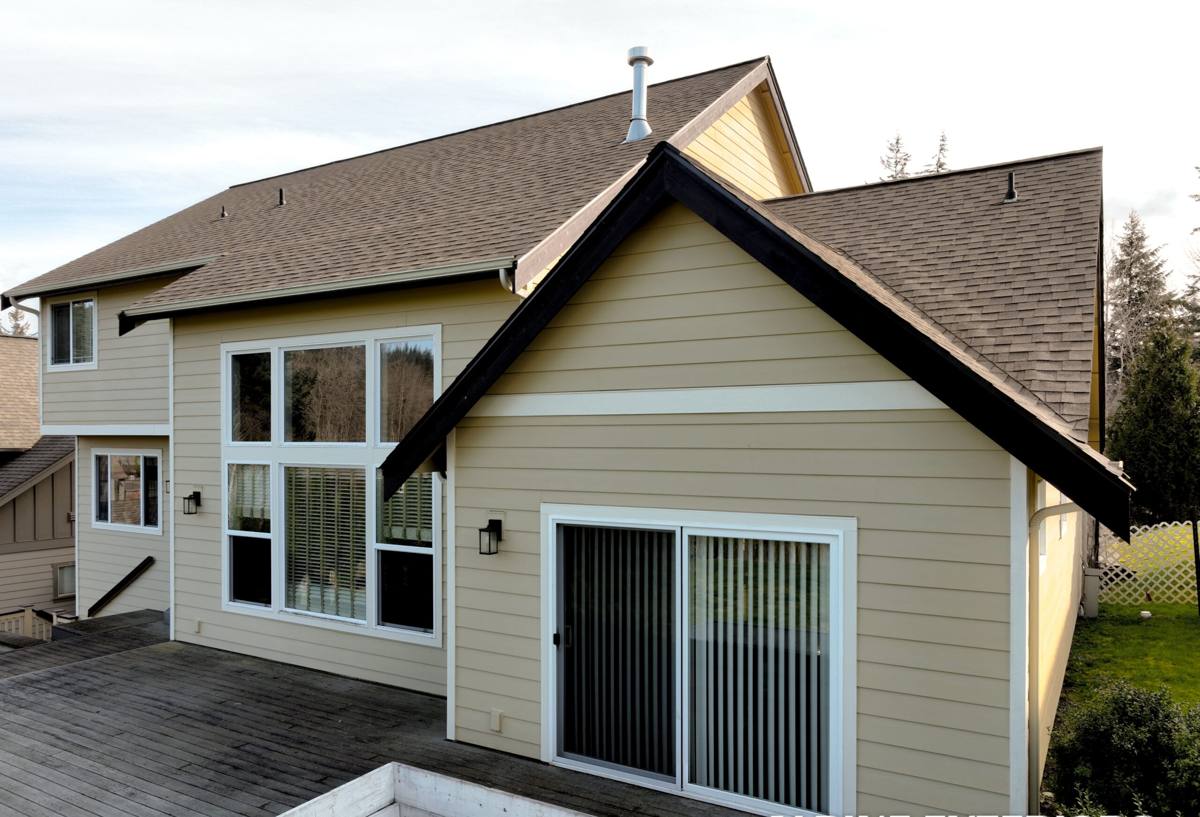
We made a decision as a company to install James Hardie fiber cement siding exclusively — not vinyl, not LP SmartSide, not Cemplank, Allura, primed spruce, or cedar. That's not a marketing position; it's a standard we hold because of what we've seen these products do (and not do) in exactly the kind of climate Capitol Hill sits in.
Fiber cement is non-combustible, dimensionally stable across wet-dry cycles, and doesn't feed moss and mildew the way wood-based products do. Hardie's factory-applied ColorPlus finish is baked on under controlled conditions rather than field-painted, which means better adhesion and color retention through repeated soak-dry cycles than a job-site paint job can typically achieve. And Hardie engineers specific product lines (HZ5 and HZ10) for different climate zones — the Pacific Northwest falls under specifications built around exactly the moisture exposure this region sees.
Wood-based composite products can perform well when the finish is intact and maintenance stays current, but any breach in that finish exposes an engineered wood core to moisture, and once that starts, the damage isn't cosmetic — it's structural, and it isn't easily reversed. Vinyl avoids that rot risk but expands and contracts significantly with temperature swings, can distort or crack in cold snaps, and is fully replaced rather than repaired when damaged. We'd rather install one product correctly and stand behind it than offer several options with different long-term outcomes.
What a Correct Fiber Cement Installation Actually Involves
Fiber cement siding is only as good as the installation behind it. Most siding failures we're called out to inspect aren't a product problem — they're a workmanship problem. A correct install includes:
- A properly lapped weather-resistant barrier behind the siding, integrated with window and door flashing rather than just stapled over the sheathing
- Correct fastener spacing and placement, using Hardie-approved fasteners driven to the manufacturer's specified depth — not overdriven, which cracks the board's face and creates a water entry point
- Minimum clearance gaps at the ground, roofline, and any horizontal surface, so siding never sits in standing water or trapped moisture
- Proper joint and seam treatment, including caulking only where Hardie specifies it and leaving butt joints designed to shed water where called for
- Correct panel and lap orientation so water is directed outward and downward at every course, not channeled behind the plane of the wall
Skipping any one of these doesn't show up as a problem in year one. It shows up in year five or eight, as staining, soft trim, or bubbling paint at a seam — by which point the fix is far more invasive than it would have been to do correctly the first time.
Our Process for Capitol Hill Siding Projects
Inspection and Scope
We start by walking the exterior and identifying what's under the existing siding where possible — old flashing, damaged sheathing, or trim that needs replacing before new siding goes on. On Capitol Hill's older homes, this step often turns up issues that were hidden for years, and we'd rather find them before the wall is closed up again.
Prep and Moisture Barrier
Any compromised sheathing or framing gets addressed before the weather-resistant barrier goes on. This is the step that determines whether the wall stays dry for the next few decades, so it doesn't get rushed regardless of schedule pressure.
Installation
Hardie boards, panels, or shingle-style siding go on to manufacturer spec, with attention to the fastening, clearance, and flashing detail described above. We account for the specific elevation exposures on the home — the side that takes the worst of the driving rain gets the same care as the sheltered side, not less.
Final Walkthrough
We walk the finished job with the homeowner, cover care and maintenance expectations, and make sure everything lines up with what was scoped at the start.
Matching Hardie Products to Capitol Hill's Housing Styles
Capitol Hill's older housing stock — Craftsman bungalows, foursquares, and early apartment conversions — often calls for a siding profile that respects the original architecture rather than flattening it into a generic look. Hardie's product range covers this:
- HardiePlank lap siding in a traditional exposure works well on Craftsman and foursquare-style homes where a classic horizontal reveal is expected
- HardieShingle siding can replicate a shingle-style look for homes where that's the original or desired aesthetic, without the maintenance burden of real cedar shingles
- HardiePanel vertical siding suits accent walls, gables, or more contemporary infill construction
ColorPlus finishes come in a range of factory colors designed to hold up through the region's soak-dry cycle without the fading and chalking that field-applied paint shows first. For homes where an exact historic color match matters, Hardie products can also be field-painted, though we'll always walk through the trade-offs of factory versus field finish before recommending one.
Cost Factors for a Capitol Hill Siding Project
Every home is different, but the same handful of factors drive most of the variation in scope and cost on Capitol Hill jobs:
| Factor | Why It Matters Locally |
|---|---|
| Access and lot conditions | Narrow lots, tight setbacks, and shared property lines common on Capitol Hill can affect staging, scaffolding, and how efficiently a crew can work an elevation |
| Condition under existing siding | Older homes may need sheathing repair, trim replacement, or full moisture barrier renewal before new siding goes on |
| Siding profile chosen | Lap, shingle, and panel products install at different rates and price points |
| Number of stories and roof lines | Multi-story homes and complex rooflines mean more cuts, more flashing detail, and more time per square foot |
| Trim and detail work | Craftsman-style trim, window surrounds, and corner detail add labor beyond the flat wall area |
We provide a written, itemized estimate after an in-person inspection rather than a rough phone quote, since so much of the actual cost depends on what's found once we're looking at the wall directly.
Why Hiring a Crew That Already Works Capitol Hill Matters
A crew that regularly works this neighborhood has already dealt with its narrow lots, its parking and staging constraints, and the realities of working close to neighboring structures without disrupting them. That familiarity translates into a smoother job — fewer surprises around access, a better sense of how King County permitting and inspection typically moves for a project like this, and an eye for the specific ways older Seattle-area homes tend to hide moisture problems behind their original siding.
It also means we're not learning on your house. We've seen how driving rain behaves against a west-facing wall on a hill lot, how moss establishes on the shaded side of a densely built block, and what happens when a previous siding job skipped flashing details that only become a problem years later. That local pattern recognition is part of what a homeowner is paying for when they hire a crew with a real track record in the neighborhood, not just in the general region.
Maintaining Hardie Siding in Seattle's Climate
Fiber cement is low-maintenance compared to wood, but "low-maintenance" doesn't mean "no maintenance" — especially with this climate's moss season. A simple annual routine keeps a Hardie install performing the way it's designed to:
- Rinse siding annually with a garden hose to clear pollen, dust, and early moss growth before it establishes
- Trim back tree branches and shrubs that keep any wall section shaded and damp longer than the rest of the house
- Check caulked joints and trim seams once a year for cracking or separation, particularly after a hard winter
- Keep gutters and downspouts clear so overflow isn't running down the siding face during heavy rain
- Address any paint chipping or staining early — on ColorPlus finishes this is rare, but it's worth catching quickly wherever it appears
If you're weighing a siding replacement for a Capitol Hill home, we're happy to walk the property, look at what's actually going on behind the existing siding, and put together a straightforward, no-pressure estimate. There's a form below to get that started.