 Seattle
 Bellevue's Climate Puts Real Stress on Siding
Bellevue sits in a part of King County where siding takes a slow, steady beating rather than one dramatic hit. Winters bring long stretches of driving rain, often pushed sideways by wind off Lake Washington and Puget Sound, which forces water into every gap, seam, and fastener hole a siding system has. Add salt-tinged marine air moving in from the Sound and you get a slow corrosion problem on fasteners and trim that homeowners further inland rarely deal with. Then there's moss. Bellevue's tree canopy and shaded, moisture-holding lots give moss and algae a long growing season — sometimes nearly year-round on north-facing walls — and that moss holds water directly against the siding surface far longer than open, sunny walls ever see.
None of this means Bellevue siding is doomed. It means siding repair here has to account for moisture that's already found its way in, not just cosmetic damage on the surface. A repair that only addresses what's visible from the driveway, without checking what's happening behind the panel, tends to fail again within a couple of seasons.
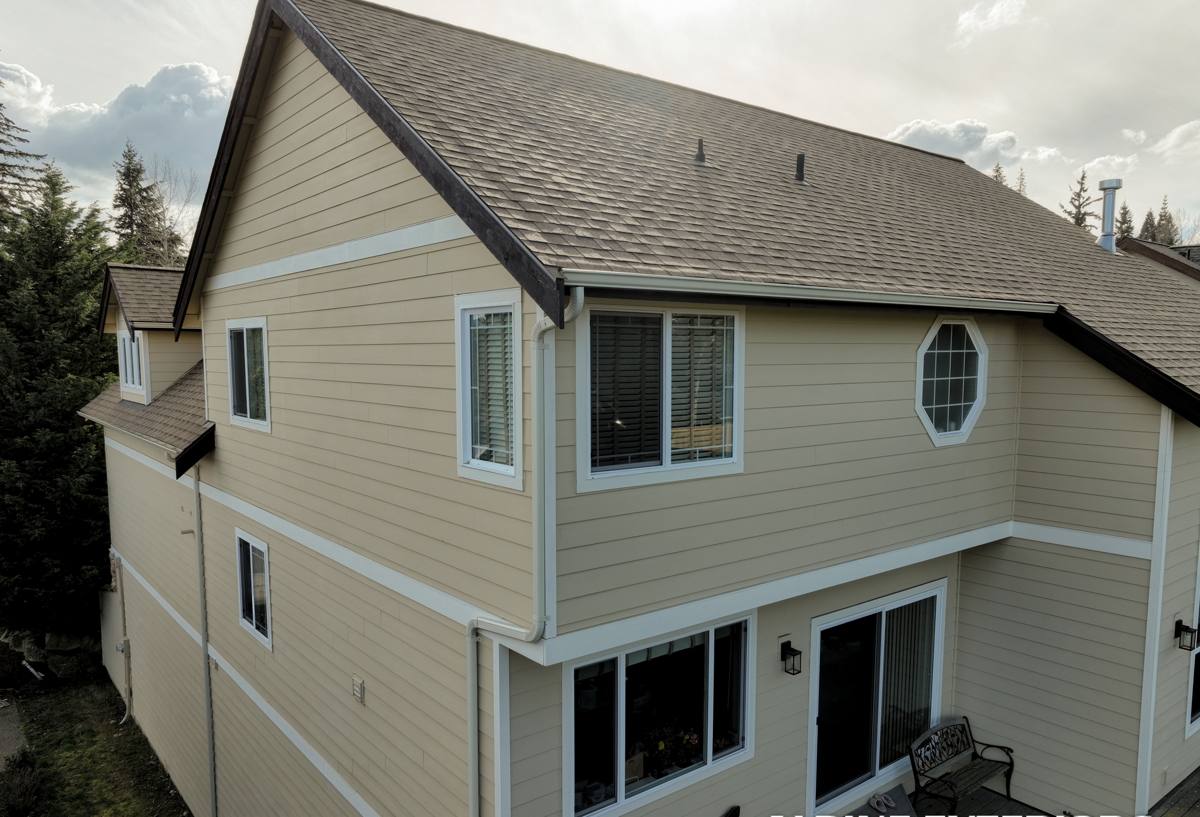
Common Siding Repair Issues We See in Bellevue Homes
Bellevue's housing stock spans decades of construction, which means the repair calls we get vary by material and by age of the home.
Older wood and cedar siding
Cedar and wood lap siding on older Bellevue homes often shows soft, punky spots at butt joints, near window sills, and at the bottom courses closest to grade — all places where water sits longest. Paint failure is usually the first visible sign, but by the time paint is peeling, moisture has typically already reached the wood fibers underneath.
Vinyl siding
Vinyl doesn't rot, but it does crack in cold snaps, warp near heat sources like dryer vents, and pop loose from its nailing hem in wind. Vinyl repairs are usually straightforward panel swaps, but they don't address anything happening behind the panel — vinyl was never designed to be a moisture barrier on its own.
Fiber cement and engineered wood
Homes with fiber cement or engineered wood siding usually have more localized problems: caulking that's failed at trim joints, a damaged corner from a fallen branch, or moisture wicking up from a failed kick-out flashing where a roofline meets a wall. These repairs are often more about flashing and sealant detail than about the siding material itself.
What a Correct Siding Repair Actually Involves
A repair that's done right starts before anyone touches the siding itself. Surface damage is a symptom — the job is figuring out the cause.
- Removing the damaged section far enough back to expose the house wrap, flashing, and sheathing underneath, not just the visibly damaged board
- Checking moisture content of the sheathing and framing with a meter, not a guess
- Confirming flashing is directing water out and away at every horizontal transition — window heads, roof-to-wall intersections, deck ledgers
- Repairing or replacing house wrap and flashing tape before any new siding goes back on
- Matching the replacement material's profile, exposure, and fastening pattern to the surrounding siding
- Sealing and finishing new material to blend with existing color and texture, where that's realistically achievable
Skipping the "why did this fail" step is the single most common shortcut in siding repair, and it's why the same spot often needs fixing again two or three years later.
Repair or Replace? How We Make That Call
Not every damaged wall needs full replacement, and not every repair is worth doing instead of replacing. The right call usually comes down to how much of the wall is affected, what's underneath it, and how old the existing siding already is.
| Factor | Repair is usually enough | Replacement is usually the better call |
|---|---|---|
| Extent of damage | Isolated to one or two boards/panels | Spread across multiple walls or elevations |
| Sheathing condition | Dry, solid when probed | Soft, delaminating, or visibly rotted |
| Age of existing siding | Under 10-15 years, otherwise sound | Nearing or past expected service life |
| Cause of failure | One identifiable event (impact, one bad flashing detail) | Systemic issue (no house wrap, widespread caulk failure) |
| Material match available | Yes — profile and color still obtainable | No — discontinued profile or badly faded field |
We'll walk you through where your home lands on that table before recommending either path — the goal is spending your money on the option that actually solves the problem, not the one that's easiest to sell.
Our Repair Process, Step by Step
Every repair job we take on in Bellevue follows the same sequence, whether it's one panel or a full wall:
- On-site inspection. We look at the damage, the surrounding wall, and anything nearby that could be contributing — downspouts, grading, tree cover, roofline transitions.
- Moisture and cause assessment. Before we quote anything, we confirm whether the sheathing behind the damage is sound and identify what let water in.
- Written scope and estimate. You get a clear breakdown of what's being repaired, what's being replaced, and why — no vague line items.
- Removal and inspection behind the wall. Damaged siding comes off, and we confirm the condition of the wrap and sheathing before closing anything back up.
- Flashing and moisture barrier correction. Any failed detail that caused the original problem gets fixed, not just covered.
- Reinstallation and finish matching. New material goes in to match the existing siding's reveal and profile as closely as possible, then gets caulked, primed, or finished appropriately.
- Final walkthrough. We show you what was found and what was done — including photos of anything that was hidden behind the old siding.
Material Matching: Working with Existing Siding vs Upgrading to Hardie
When a repair involves replacing a section of existing wood, vinyl, or engineered wood siding, we'll match that material where it makes sense — a small, isolated repair rarely justifies re-siding a whole wall in a different product. But we're upfront that we only install James Hardie fiber cement as our own product line, and there are situations where a repair conversation turns into a legitimate replacement conversation:
- When the damaged section is large enough that a patch would be visually obvious no matter what material is used
- When the existing material (older LP SmartSide, primed spruce, or cedar) is failing broadly, not just in the repaired spot
- When a homeowner is already planning a repaint or refresh and wants to stop the repair cycle for good
In those cases, we'll explain honestly why we recommend Hardie's fiber cement over re-installing the original material — it's non-combustible, holds a factory ColorPlus finish instead of relying on repeated repainting, and is engineered for wet climates like ours rather than adapted to it. We won't push a full re-side when a targeted repair will genuinely hold up; that recommendation only comes up when the wall itself is telling us it's time.
Signs Your Bellevue Home's Siding Needs a Repair Call
- Paint that's peeling, bubbling, or alligatoring in the same spot repeatedly
- Soft or spongy siding when you press on it, especially near the bottom courses
- Visible gaps, cracks, or warping, particularly after a cold snap or windstorm
- Persistent moss or dark staining on north- or shade-facing walls
- Musty smells or discoloration on interior walls that back up to exterior siding
- Caulk that's cracked, shrunk, or pulled away from trim and window edges
- Siding that's warm or damp to the touch near a roofline or deck ledger after rain
Why a Crew That Already Works Bellevue Matters
Siding repair diagnosis depends heavily on knowing what's typical for the area you're working in. A crew that repairs siding across a wide range of King County climates knows to expect moss-driven moisture on shaded Bellevue lots, understands how marine air affects fastener corrosion near the water, and recognizes the flashing mistakes that show up again and again on homes with complex rooflines under mature tree cover. That local pattern recognition shortens the diagnostic process and reduces the chance of a repair that looks fine but fails again next wet season. It also means we're not guessing at permitting norms or typical construction practices for this area — we already know them.
If you're seeing warning signs on your Bellevue home's siding, or you just want an honest read on whether a repair will actually hold, we're glad to take a look. We offer free, no-pressure estimates — one of our crew will inspect the damage, tell you what we find behind the surface, and lay out your real options in plain terms. There's no obligation attached to asking.