 Seattle
 Why Ballard Decks Wear Out Faster Than the Brochure Says
Ballard sits close enough to Shilshole Bay and Puget Sound that salt-laden air is a daily fact of life for anything built outside, not just for boats at the marina. Add King County's long wet season, heavy tree canopy on many older lots, and a stretch of gray months where a deck barely sees direct sun, and you get a combination that's tough on outdoor structures: metal hardware corrodes faster, moisture sits in end grain and fastener holes longer than it should, and moss and green algae get a real foothold on any surface that stays damp and shaded. None of that means composite decking is a bad choice here — it's usually the right one. It means the details of how it's built matter more in Ballard than they would in a drier inland neighborhood.
We work on decks throughout Seattle, but a fair number of our composite decking jobs are in Ballard specifically, on everything from older bungalow lots to newer infill construction. The climate challenges repeat from job to job, and so does the fix: correct substructure, the right fasteners, and a board system chosen for how it actually performs when it's wet more often than it's dry.
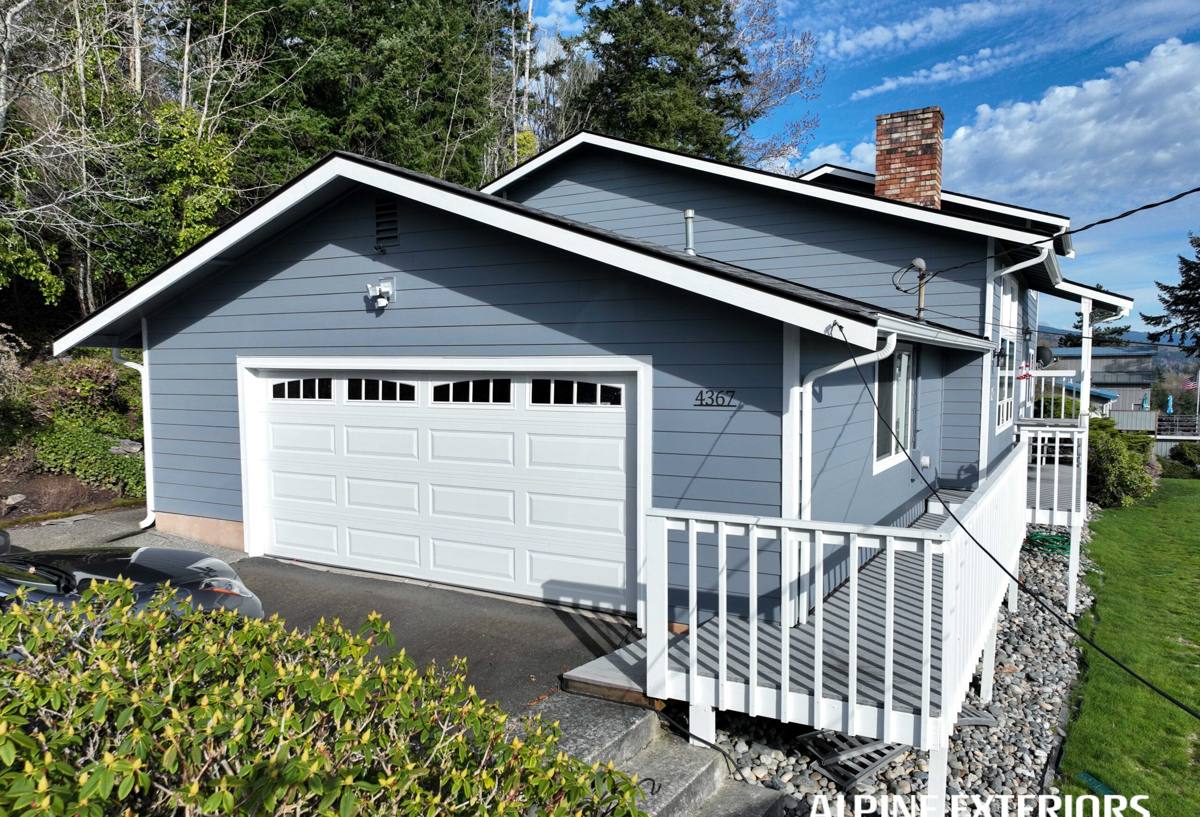
What Ballard's Climate Actually Does to a Deck
Salt Air and Metal Hardware
Homes closer to the water take the brunt of this, but salt-tinged marine air travels further inland than most homeowners expect, especially on windy days. Standard zinc-coated screws and brackets can start showing rust streaks within a couple of seasons in exposed spots. This is a hardware and fastener decision, not just a board decision — the composite decking itself may be fine while the connectors underneath are quietly failing.
Rain Volume and Duration
It's not just the number of rainy days King County gets — it's how long moisture stays in contact with wood framing, joist tops, and fastener penetrations between dry spells. A deck built without proper drainage and joist protection will trap water in exactly the places you can't see, which is where rot starts.
Moss, Algae, and Shade
Ballard's mix of mature trees and closely spaced homes means a lot of decks get partial shade for much of the day, especially through fall and winter. Combined with rain, that's ideal moss and algae growing conditions. Composite boards resist this better than untreated wood, but board texture, drainage gaps, and airflow underneath the deck all affect how much moss actually takes hold.
What a Correctly Built Composite Deck Involves
Composite decking's reputation lives or dies on the installation, not just the boards. A poorly built substructure will undermine even a premium composite board line. The fundamentals we treat as non-negotiable on every Ballard project:
- Joist tape or a comparable moisture barrier on every joist top, not just at the ledger
- Corrosion-resistant, coated or stainless fasteners and structural connectors rated for exterior/coastal-adjacent use
- Proper board spacing for expansion and drainage — composite still moves with temperature, just less than wood
- Adequate ventilation and clearance underneath the deck so air can actually circulate and dry out damp framing
- A ledger board attachment (when the deck attaches to the house) that's properly flashed to keep water out of the rim joist and wall assembly
- Hidden fastener systems installed to the manufacturer's exact spacing tolerances, since incorrect spacing is a common cause of board buckling
Skipping any one of these doesn't usually show up as a problem in year one. It shows up in year three or four, as soft framing, corroded brackets, or boards that have started to cup — right about the time most homeowners assume "composite means maintenance-free" and stop checking.
Composite vs. Other Decking Materials for a Ballard Property
| Material | Moisture/Salt Air Behavior | Moss & Algae Resistance | Maintenance |
|---|---|---|---|
| Capped composite | Strong — cap layer sheds water, doesn't absorb like wood | Good, especially textured/streaked colors that hide surface growth | Periodic wash; no staining or sealing |
| Pressure-treated wood | Absorbs moisture readily; treatment slows but doesn't stop rot | Poor — porous surface holds moisture and organic film | Annual sealing/staining, regular inspection for soft spots |
| Cedar | Naturally rot-resistant but still absorbs water over time | Fair when maintained, poor when neglected | Regular sealing; grays and weathers without upkeep |
| PVC decking | Excellent — fully synthetic, doesn't absorb moisture | Good, similar to capped composite | Low; can be more brittle in cold, less common locally |
Capped composite is where most of our Ballard clients land, largely because it balances upfront cost, appearance, and the low ongoing maintenance that makes sense for a busy household that doesn't want a deck as a recurring chore. Uncapped or lower-grade composite is a different story — it absorbs more moisture at the surface and is more prone to mold staining in a climate this wet, which is why we don't recommend it here even though it costs less upfront.
Choosing the Right Board for a Ballard Home
Not every composite board line is built the same way, and the differences matter more in a wet, shaded climate than a dry one.
Cap Layer Quality
A full cap (top and bottom, or fully wrapped) sheds water better than a board capped only on the visible face. In a climate where boards rarely get a chance to fully dry out between rain events, that matters.
Color and Texture
Lighter, uniform colors show pollen, dirt, and early moss growth more visibly than streaked, multi-tonal boards. Under Ballard's tree cover, a board with some texture and color variation stays looking clean longer between washes — a practical consideration, not just an aesthetic one.
Board Profile
Grooved-edge boards paired with hidden fastener clips give the cleanest look and the best drainage between boards. Face-screwed boards are more budget-friendly but leave exposed fastener heads that are the first thing to show corrosion in salt air.
Our Process, Start to Finish
- Site evaluation — we look at drainage, shade exposure, existing structure condition (if replacing an old deck), and how close the property sits to the water, since that affects our hardware recommendation
- Design and board selection — matched to your home, budget, and how the space actually gets used
- Permitting — Seattle requires permits for most new decks and many substantial replacements; we handle the paperwork and inspections
- Demo (if applicable) — removal of the old deck, with an honest look at whether the ledger and any structural posts underneath are sound enough to reuse
- Framing and substructure — joist layout, moisture barrier, corrosion-resistant hardware, proper drainage slope
- Decking installation — boards, fastening system, edge and stair details, railings
- Final walkthrough — we go over care basics specific to your board choice and site conditions
Maintaining a Composite Deck in a Wet, Salty Climate
"Low-maintenance" doesn't mean "no maintenance," especially this close to the water. A composite deck in Ballard still needs periodic attention to stay ahead of moss and to catch hardware issues before they become structural ones.
- Sweep debris and standing leaves off the deck regularly through fall — trapped organic matter is what feeds moss and algae growth
- Wash the surface with a soft-bristle brush and mild soap a couple of times a year; a pressure washer on the wrong setting can damage the cap layer
- Check visible fasteners, brackets, and railing hardware once a year for early rust or corrosion, especially if the deck faces the water or gets direct wind off the Sound
- Keep the space underneath the deck clear of stored items that block airflow and trap moisture against the framing
- Clear gutters and downspouts near the deck so runoff isn't draining directly onto or under it
- Address any soft, spongy, or discolored framing immediately — composite boards can look fine while the structure underneath is failing
Permits, Codes, and Structural Considerations
Most new decks and many deck replacements in Seattle require a permit, and King County building code sets specific requirements for guardrail height, baluster spacing, ledger attachment, and footing depth. This isn't paperwork for its own sake — it's what keeps a deck safe to actually use, especially with stairs or a railing involved. We pull the required permits and build to code as a matter of course, not as an upsell. If your lot has specific constraints — a narrow side yard, a steep grade, an older foundation — we plan around those rather than discovering them mid-project.
Why a Local Crew Matters for This Job
Composite decking installation isn't neighborhood-specific in the abstract, but the judgment calls involved usually are. Knowing how close a given block sits to the water, how much shade a typical Ballard lot gets from mature trees, and which older homes tend to have undersized or aging ledger attachments comes from doing this work here repeatedly, not from a manufacturer's install guide. A crew that already works Ballard regularly isn't guessing at hardware specs or drainage details — they've already seen what fails in this climate and what holds up. That translates into fewer surprises during the build and a deck that's set up to handle the specific conditions of your property, not just generic Pacific Northwest weather.
If you're planning a new deck or replacing one that's showing its age, we're happy to take a look and put together a straightforward estimate — no pressure, no upsell script. Use the form below to tell us a bit about your project and we'll get back to you.