 Seattle
 Renton's Climate and What It Does to Siding
Renton sits in the wettest part of a wet region. Between Lake Washington to the north, the Cedar River running through town, and the marine air that moves through the Puget Sound lowlands, homes here deal with near-constant moisture for much of the year. Add King County's long gray season and you get conditions that are hard on any exterior: driving rain that gets pushed sideways into wall assemblies, humidity that never fully lets up, and shaded, damp yards where moss and algae take hold on siding, trim, and roofing alike.
Wood-based products suffer the most in this environment — swelling, cupping, and rot show up at seams, butt joints, and anywhere water gets trapped against the substrate. Vinyl holds up to moisture fine on its own, but it's a thin plastic skin that flexes with temperature and gives you nowhere to go if you want a heavier, more substantial look. Fiber cement, done correctly, is built for exactly this kind of climate — it doesn't absorb water into its core the way wood-based sidings do, and it holds paint and factory finish far longer than wood substrates in a damp climate like Renton's.
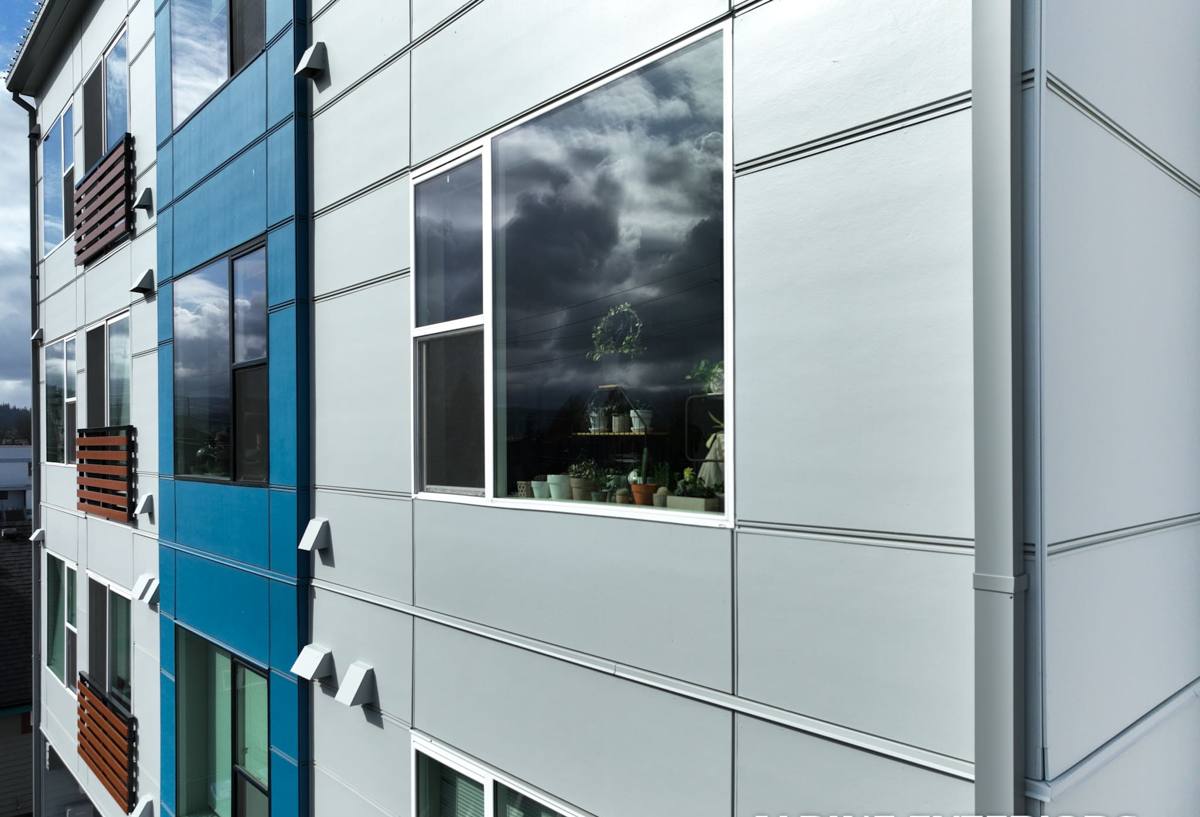
Why We Only Install James Hardie in This Climate
We don't install every brand of fiber cement, and we don't install LP SmartSide, vinyl, primed wood, or cedar. That's a deliberate standard, not a sales pitch. James Hardie engineers specific product lines for different climate zones — the HZ5 line used in the Pacific Northwest is formulated for regions with sustained moisture exposure, which matters more in Renton than it would in a dry climate. The ColorPlus factory finish is baked on in a controlled environment, which gives it a more consistent, durable bond than field-applied paint — an advantage that shows up most in a climate where field-painted surfaces get very little drying time between rain events.
Hardie is also non-combustible, which matters given wildfire smoke seasons have become a recurring late-summer issue across Washington, and it carries a strong transferable warranty when installed to the manufacturer's specifications. That last part — installed to spec — is doing a lot of work in that sentence, and it's the next section.
What Correct Installation Actually Involves
Fiber cement siding's reputation is only as good as the crew installing it. The material itself is durable, but a huge share of the "siding failed early" stories in wet climates trace back to installation shortcuts, not the product. Getting it right in a climate like Renton's means:
- Proper weather-resistive barrier and rainscreen or drainage plane behind the siding, so any moisture that does get past the surface has somewhere to drain and dry
- Correct flashing at every window, door, and roof-to-wall intersection — this is where the majority of hidden leaks originate
- Minimum clearances maintained between the bottom of the siding and grade, decks, roofing, and other horizontal surfaces, so splash-back and standing moisture don't sit against the material
- Butt joints caulked or flashed per Hardie's specifications, not just butted tight and painted over
- Fasteners set at the correct depth and spacing — overdriven nails crack the board's outer layer and create a moisture entry point
- Field-cut edges primed or sealed before installation, since raw cut edges are the most vulnerable part of any fiber cement board
Skip any one of these and you can end up with the exact moisture problems fiber cement is supposed to solve — trapped water behind the cladding, paint failure at joints, or premature warranty issues. This is why the installer matters as much as the product choice.
Our Process for a Renton Fiber Cement Job
We start with an on-site assessment of the existing siding and wall assembly — what's underneath matters as much as what's going on top, especially on older Renton homes where the sheathing or weather barrier may need attention before new siding goes on. From there:
- Tear-off and inspection: Remove existing siding and check the sheathing, framing, and any flashing already in place for hidden rot or moisture damage before anything new goes up.
- Weather barrier and drainage plane: Install or verify the weather-resistive barrier and a drainage gap appropriate for a wet climate, so bulk water has an exit path.
- Flashing: Detail every penetration — windows, doors, hose bibs, vents, roof lines — before any siding board touches the wall.
- Siding installation: Hang James Hardie boards or panels to manufacturer spec — correct fastener pattern, joint treatment, and clearances at grade, decks, and roofing.
- Trim and detail work: Corner boards, fascia, and trim installed with the same flashing and clearance discipline as the field siding — trim failures are just as common as field siding failures if rushed.
- Final walk-through: We review the finished work with the homeowner and point out anything they should know about long-term care.
Fiber Cement vs. Other Siding Options
| Material | Moisture behavior in wet climates | Finish durability | Why we do or don't install it |
|---|---|---|---|
| James Hardie fiber cement | Does not absorb water into its core; engineered HZ5 line for the Pacific Northwest | Factory-baked ColorPlus finish holds up well between rain events | Our standard install |
| LP SmartSide / wood-strand products | Engineered wood core is more moisture-sensitive at cut edges and joints | Field or factory finish, more maintenance-dependent | Not installed — moisture sensitivity is a poor fit for this climate |
| Vinyl siding | Sheds water well but flexes, warps, and gaps with temperature swings | Color is through the material but fades and chalks over time | Not installed — thin profile, limited repair options |
| Primed wood or cedar | Absorbs and releases moisture readily; prone to cupping and rot in constant damp | Requires repainting on a recurring cycle | Not installed — highest long-term maintenance burden in this climate |
What Affects the Cost of a Job Like This
Every Renton home is different, and we won't quote a number without seeing the house, but the main variables that move the price are worth understanding before you get bids:
| Factor | Why it matters |
|---|---|
| Tear-off scope | Full removal of old siding down to sheathing costs more than installing over a compliant existing assembly, but it lets us find and fix hidden moisture damage |
| Sheathing or framing repair | Homes with existing rot or water intrusion need that addressed before new siding goes on — this is common on older homes in wet neighborhoods |
| Board profile and texture | Lap siding, panel systems, and shingle-style profiles have different material and labor costs |
| Trim and detail complexity | Homes with more corners, window trim, and roofline transitions take more labor to flash and finish correctly |
| Story height and access | Two-story and steep-lot homes require more scaffolding or lift time |
Living With Fiber Cement in Renton's Climate
Once it's installed correctly, fiber cement asks for very little. It won't rot, and it doesn't need the periodic repainting that wood siding does. What it does benefit from in this climate is the same thing every exterior surface in King County benefits from: keeping gutters clear so water isn't sheeting down the wall face, trimming back vegetation and tree cover that keeps siding shaded and damp longer than it needs to be, and rinsing off moss or algae growth before it gets a long-term foothold. None of this is unique to fiber cement — it's just Puget Sound home maintenance — but it matters more in shaded, moisture-heavy yards than in drier ones.
Why a Local Crew Matters for This Job
Flashing details, clearance requirements, and drainage planes aren't abstract code items — they're the difference between siding that lasts decades and siding that fails at year five. A crew that installs siding across a range of climates has to relearn those details every time the region changes. A crew that works Renton and the surrounding King County area regularly already knows what this climate does to a wall assembly, what kind of moisture problems show up on which house styles, and where past installations in this area tend to go wrong. That familiarity shows up in the details you can't see once the siding is on — the flashing behind the trim, the drainage gap behind the boards, the caulk joints that were actually done to spec instead of just caulked over.
A Few Questions Worth Asking Any Contractor Before You Sign
- Will you install a drainage plane or rainscreen gap behind the siding, and can you explain why?
- How do you flash windows, doors, and roof-to-wall transitions specifically?
- What clearance will the bottom of the siding have from grade, decks, and roofing?
- Is the product manufacturer-authorized, and does the installation qualify for the full transferable warranty?
- Will you inspect and repair sheathing or framing issues found during tear-off, or just cover them up?
If a contractor can't answer those clearly, it's worth getting a second opinion before committing to a full siding replacement.
If you're weighing a siding replacement or repair in Renton, we're happy to take a look and walk you through what your home actually needs — no pressure, no obligation. Reach out for a free estimate using the form below.