 Seattle
 Decking Built for Rainier Valley's Climate, Not Just Its Look
Rainier Valley sits in a part of Seattle that gets the full range of what King County weather can do to an outdoor structure: long stretches of driving rain from fall through spring, humid air that lingers under tree canopy and near Lake Washington, and short, intense dry spells in summer that can shrink and stress wood after months of saturation. Add in the moss and algae that thrive here for a good chunk of the year, and you have a climate that is genuinely hard on a deck that isn't built and maintained correctly.
Composite decking is a strong fit for this environment when it's installed the right way. It doesn't absorb water the way wood does, it won't splinter or rot, and it resists the moss and mildew staining that plague wood decks left in shade or under trees. But composite is not maintenance-free or mistake-proof. A poorly framed or poorly ventilated composite deck will still trap moisture, grow algae in the grooves, and fail early — just in different ways than a wood deck does. The material only performs as well as the installation underneath it.
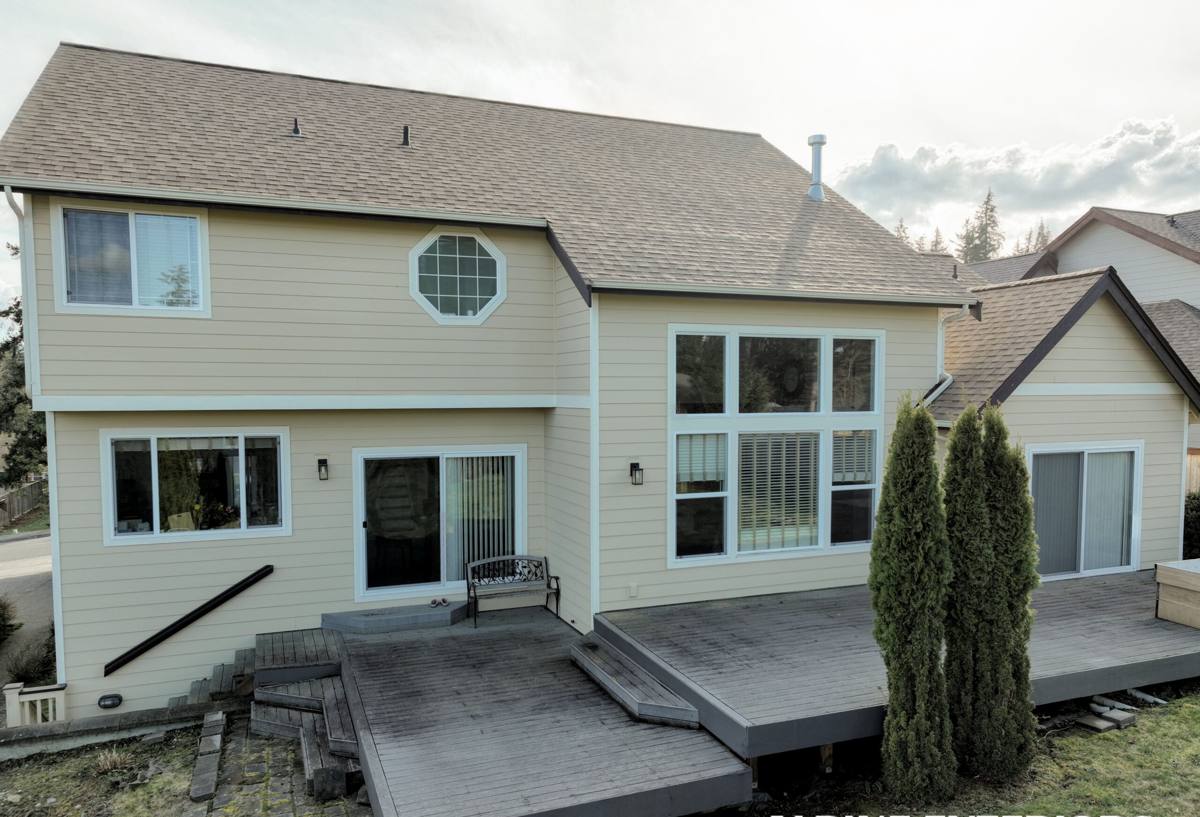
What Correct Composite Decking Actually Requires
A lot of decking problems we get called out for in this part of Seattle aren't material failures — they're installation shortcuts that didn't account for how wet this region stays for so much of the year. A correct composite deck install involves a few things that are easy to skip and expensive to fix later.
Substructure and Framing
Composite boards are heavier than wood and behave differently under load and temperature swings. Joist spacing needs to match the manufacturer's spec for composite specifically — usually tighter than what you'd use for a wood deck — especially on diagonal or picture-frame layouts. We use pressure-treated or coated framing lumber and joist tape on top of the joists to keep moisture from wicking up into the frame from underneath, which is one of the most common hidden failure points on decks in wetter Seattle neighborhoods.
Drainage and Ventilation
This is the piece that matters most in a climate like ours. Composite decking needs airflow underneath it to dry out between rain events. Decks built low to the ground, over poorly graded soil, or without adequate gaps for water to escape end up staying damp for weeks at a time, which is exactly what lets moss and mildew take hold in board grooves and along fastener lines. We grade and, where needed, add drainage beneath the deck so water moves away from the structure instead of sitting under it.
Fastening and Board Gaps
Composite boards expand and contract with temperature more than most homeowners expect. Gaps that are too tight will buckle over time; gaps that are too wide catch debris and hold moisture. We follow manufacturer spacing guidelines and adjust slightly for the specific product's expansion rate, factoring in that our summers can bring real heat swings even though our winters stay mild and wet.
Composite vs. Wood vs. PVC for This Climate
Homeowners in Rainier Valley usually narrow their decision down to composite, PVC, or traditional wood. Here's how they actually compare when the deciding factor is our wet, moss-prone climate rather than price alone.
| Material | Moisture Behavior | Moss/Algae Resistance | Maintenance | Typical Lifespan Here |
|---|---|---|---|---|
| Composite decking | Doesn't absorb water into the board core; can still trap surface moisture if airflow is poor | Good, but grooved profiles can hold grime without periodic cleaning | Occasional washing; no staining or sealing | 25–30+ years with correct install |
| PVC decking | Fully moisture-resistant, doesn't absorb water at all | Very good; smoother surfaces shed algae more easily | Occasional washing | Similar to or longer than composite |
| Pressure-treated wood | Absorbs water readily; prone to cupping and splitting through wet/dry cycles | Poor without regular sealing; moss and mildew take hold quickly in shade | Annual cleaning, sealing, or staining | 10–15 years, often less in shaded yards |
PVC is worth mentioning honestly: it performs very well in wet climates and is a reasonable alternative to composite. We install both, and which one makes sense depends on your budget, the look you want, and how much shade and ground contact the deck will have. We'll talk through that trade-off directly rather than pushing one product because it's what we happen to have on the truck.
Our Process for a Rainier Valley Composite Deck
The process is the same core steps for every composite deck, but the details we pay attention to are shaped by what actually causes decks to fail in this part of Seattle.
- Site assessment — we look at drainage, sun/shade exposure, tree cover, and existing ground moisture before we design the substructure.
- Framing and grading — joists spaced to composite spec, protective tape on joist tops, and grading beneath the deck to move water away rather than let it pool.
- Ledger and flashing work — where the deck attaches to the house, correct flashing keeps water from working its way behind siding, which is one of the most damaging and least visible failure points on attached decks in a rainy climate.
- Board installation — manufacturer-spec fastening and gapping, adjusted for expected temperature swings.
- Railings, stairs, and finish work — matched to the composite system so warranty coverage stays intact.
- Walkthrough — we go over basic care so the deck actually gets the lifespan the material is capable of.
Moss, Mildew, and Realistic Maintenance
No decking material in Seattle is maintenance-free, composite included. What changes is how much work it takes. A wood deck in a shaded Rainier Valley yard often needs sealing or staining every year or two just to keep moss from getting a foothold. Composite doesn't need that, but it still benefits from an occasional rinse or light scrub, especially in grooved-profile boards where pollen, needles, and grit can build up and hold moisture against the board surface.
Homes near tree cover or with decks that stay in shade most of the day should expect to clean the surface more often than a deck that gets full sun. This isn't a defect in the material — it's just what happens anywhere moisture sits on a surface for extended periods, and it's true of every decking material we install. The difference with a correctly built composite deck is that the cleaning is cosmetic, not structural.
What Drives Cost on a Composite Deck Project
| Factor | Why It Matters |
|---|---|
| Deck size and shape | Square footage and complexity (diagonal patterns, curves, multiple levels) affect material use and labor time |
| Substructure condition | Replacing or reinforcing an existing frame adds cost but is often necessary for a composite deck to perform correctly |
| Height and access | Elevated decks need railings, stairs, and sometimes footings that ground-level decks don't |
| Composite product tier | Board profiles, color/cap technology, and warranty length vary by manufacturer and price point |
| Site conditions | Slope, drainage work, and tree removal or trimming can add scope |
We give honest, itemized numbers based on your actual site rather than a flat per-square-foot quote that doesn't account for what's underneath the deck. Broad ranges vary a lot project to project, which is why we walk the site before giving a real estimate.
Why a Crew That Works Rainier Valley Matters
Decking failures we get called to fix are rarely about the composite boards themselves — they're almost always about a substructure or drainage decision that didn't account for how long this region stays wet. A crew that works across King County generally will build a technically sound deck. A crew that regularly works in Rainier Valley specifically has already seen how the local mix of tree cover, soil drainage, and rain patterns plays out on real decks over years, not just at installation.
That local pattern recognition shows up in small decisions: how much slope to build into the substructure, where moss tends to establish first on a given lot orientation, and which ledger and flashing details actually hold up through a full wet season here rather than just passing inspection on install day.
Questions Worth Asking Any Decking Contractor
- Will you show me the joist spacing and framing plan before boards go down?
- How are you handling drainage and airflow underneath the deck?
- What flashing method will you use where the deck meets the house?
- Does the composite product's warranty require a specific installation method, and will the install meet it?
- What's the realistic maintenance schedule for this deck given its sun/shade exposure?
- Can you show examples of decking work you've done in this area, not just general portfolio photos?
If a contractor can't answer the framing and drainage questions specifically, that's worth noticing — those details matter more to how long the deck lasts than the brand of composite board you choose.
Get a Straight Estimate for Your Rainier Valley Deck
If you're weighing composite decking for a home in Rainier Valley, we're glad to walk the site, look at your drainage and sun exposure, and give you a straightforward estimate with no pressure to decide on the spot. Use the form below to request a free estimate.