 Seattle
 Capitol Hill's Climate Is Hard on a Roof
Capitol Hill sits in one of the wetter, greener corners of Seattle, and that combination is exactly what shortens a roof's working life. Puget Sound's marine climate keeps King County damp for much of the year, and roofs here rarely get the long dry stretches that let materials fully shed moisture and dry out between storms. Add in Capitol Hill's mature tree canopy, where leaves, needles, and seed pods collect in valleys and behind chimneys, and you get the exact conditions moss needs to take hold: shade, organic debris, and near-constant moisture. Once moss establishes itself, it holds water against the roofing material far longer than open sky and sun ever would, and over years that trapped moisture works its way into seams, fasteners, and eventually the deck underneath.
Driving rain is the other half of the problem. When wind pushes rain sideways instead of straight down, water finds every weak lap, exposed fastener, and undersized flashing detail a roof has. And because Capitol Hill's air carries the same Puget Sound salt influence as the rest of the region, exposed metal such as flashing, fasteners, and vents corrodes faster here than it would in a dry inland climate. None of this means Capitol Hill roofs fail early through bad luck. It means the materials and installation details matter more here than they would somewhere drier, and a replacement done to a generic, one-size-fits-all standard usually underperforms.
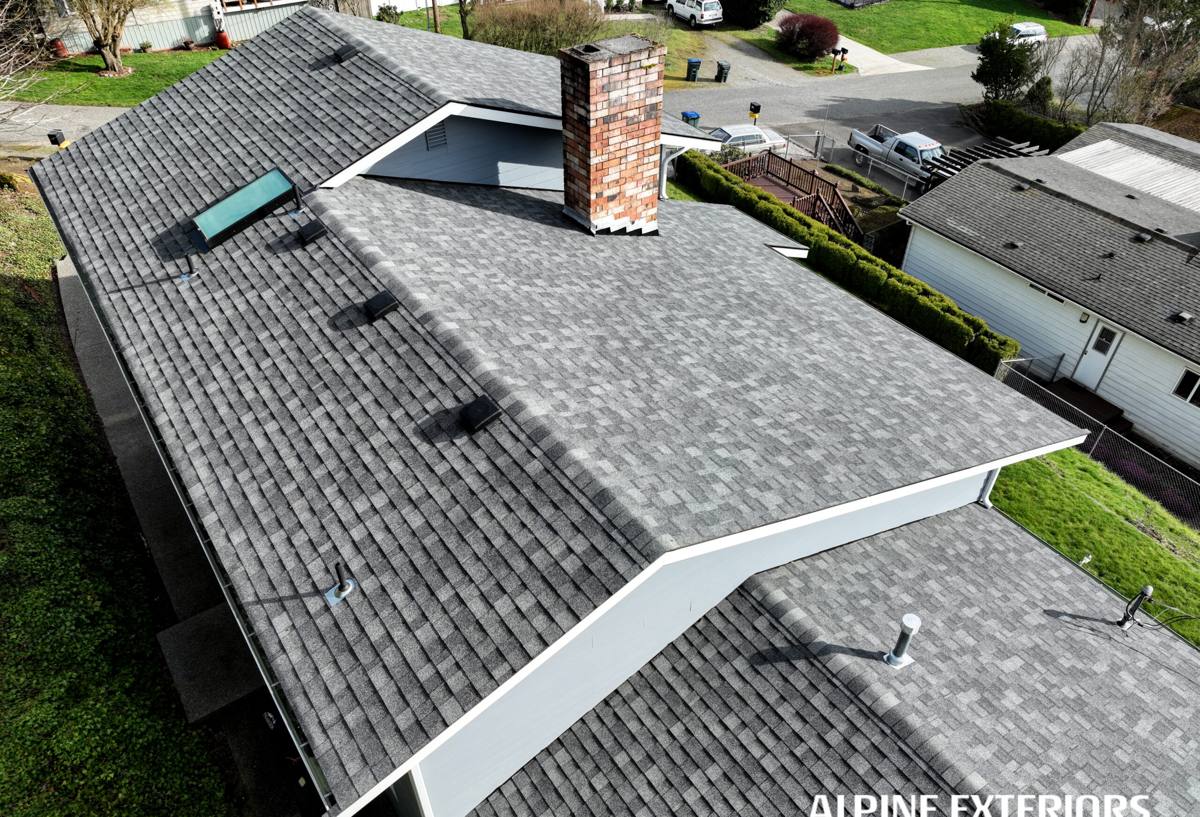
What a Correct Roof Replacement Actually Involves
A roof replacement is more than stripping old shingles and nailing down new ones. Done right, it starts with a full tear-off, not an overlay. Overlaying new shingles over old ones is faster and cheaper, but it hides the one thing you actually need to see before spending money on a new roof: the real condition of the decking underneath. On homes with any history of moss, moisture staining, or past leaks — common across Capitol Hill's older housing stock — the deck needs to be inspected board by board, with any soft, delaminated, or water-stained sheathing replaced before anything new goes down.
From there, the details that separate a roof built for this climate from one that just looks new when it's finished:
- Self-adhering ice-and-water membrane at eaves, valleys, and around every penetration — the spots where driving rain does the most damage
- Synthetic underlayment across the full deck as a second line of defense against wind-driven rain
- Step flashing at every wall intersection and kick-out flashing where a roof edge meets a wall, so water can't run behind the siding
- The correct fastener pattern and count for the manufacturer's wind rating, not just "enough to hold it down"
- Balanced intake and exhaust ventilation, sized to the actual attic rather than a generic vent count
Matching the System to Capitol Hill's Housing Stock
Capitol Hill's mix of early-twentieth-century craftsman and Tudor-style homes, later infill construction, and multi-family buildings means no single roofing approach fits every house. Steep-pitched single-family roofs with dormers need careful valley and flashing work, and they shed water well once that's done right. Additions, porches, and some multi-family buildings carry lower-slope sections that shingles were never designed for and need a membrane system instead. Part of a correct estimate is identifying which parts of your roof are steep-slope and which are low-slope, then specifying the right material for each, rather than putting one shingle system on the whole building because it's simpler to quote.
Comparing Roofing Systems for This Climate
Costs below are broad ranges — exact pricing depends on roof size, pitch, access, and how much deck repair is needed.
| System | Typical Lifespan | Moss & Moisture Resistance | Relative Cost | Best Fit |
|---|---|---|---|---|
| Architectural (dimensional) shingle | 25–30 years | Good, with proper underlayment and clean valleys | $$ | Most steep-slope single-family roofs |
| Standard 3-tab shingle | 15–20 years | Fair — thinner profile sheds debris less easily | $ | Budget replacements on simple roof shapes |
| Standing seam metal | 40–50+ years | Excellent — smooth surface sheds moss and debris | $$$ | Long-term owners, steep or complex rooflines |
| Low-slope membrane (TPO/modified bitumen) | 20–25 years | Good, when properly detailed and drained | $$–$$$ | Additions, porches, flat or near-flat sections |
Our Roof Replacement Process
- On-site inspection and honest estimate. We climb the roof, check the attic and deck where accessible, and walk you through what's actually needed versus optional, with no pressure to decide on the spot.
- Material selection and permit. Once you've chosen a system, we file the required City of Seattle permit before any work begins on a full reroof.
- Property protection. Tarps go over landscaping and driveways, and we plan around parked cars and the tighter street access common on Capitol Hill lots before the crew ever shows up.
- Full tear-off and deck inspection. Old roofing comes off down to the sheathing, and any compromised boards are replaced before new material goes down.
- Underlayment and flashing. Ice-and-water shield, synthetic underlayment, and step and kick-out flashing go in at every vulnerable point.
- New roofing system and ventilation. The chosen system is installed to manufacturer specification, with intake and exhaust ventilation balanced for your attic.
- Full cleanup and magnetic sweep. Nails and debris are cleared from the yard, driveway, planting beds, and street before we call the job done.
- Final walkthrough. We review the finished roof and the paperwork together — warranty registration and permit close-out included.
Ventilation and Moisture: The Part Most Homeowners Never See
A roof can be installed with premium materials and still fail early if the attic underneath can't breathe. In a climate as damp as ours, warm moist air rising into an attic needs somewhere to go. Without balanced intake and exhaust ventilation, that moisture condenses on the underside of the deck, and over time it rots sheathing from the inside — the opposite direction most homeowners are watching for leaks. Poor ventilation also traps summer heat, which speeds up shingle aging, and it makes attics more prone to condensation-driven mold rather than the ice-damming problems homes see in colder climates. Sizing intake and exhaust correctly for your specific attic volume is a calculation, not a guess, and it should be part of any full roof replacement — not an afterthought.
Permits and Working in a Dense Neighborhood
Any full reroof in Seattle requires a permit through the Department of Construction and Inspections, and that paperwork should be handled before the first shingle comes off, not after a complaint. Capitol Hill adds its own layer of logistics: narrow lots, shared driveways and alleys, street parking that fills up fast, and in a few pockets, design or historic review that can affect what's visible from the street. A crew that already works this neighborhood knows to plan around these things — where to stage material, how to keep a dumpster or trailer from blocking shared access, and when a project needs sign-off beyond the standard permit — instead of finding out mid-job.
Signs Your Capitol Hill Roof Needs Replacing, Not Just Repair
Some of the items below are repairable on their own. But when two or more show up together, especially on a roof already past the twenty-year mark, repair costs usually start rivaling replacement without buying you much additional life.
- Granules collecting in gutters and downspouts in noticeable amounts
- Shingles curling, cracking, or lifting at the edges
- Moss returning heavily within months of a cleaning instead of a full season or more
- Daylight visible through the attic sheathing, or a damp, musty smell in the attic
- Staining or active leaks around chimneys, skylights, or where the roof meets a wall
- Sagging or soft spots anywhere on the roof plane
- An asphalt roof 20–25 years old or older that's never been fully replaced
- Missing or damaged shingles after a windstorm
Why Hire a Crew That Already Works Capitol Hill
Roofing crews unfamiliar with this neighborhood learn its logistics on your job, at your expense. That can mean figuring out permit requirements as they go, dealing with a lot that has no easy staging area, or under-bidding a job because they didn't account for a steep, tree-covered pitch until they were already on the roof. A crew with real Capitol Hill experience already knows the housing stock, has working relationships with local suppliers for faster material turnaround, and can give you an estimate that reflects the real conditions of your specific roof and lot rather than a generic number that gets adjusted after the fact.
If your Capitol Hill roof is showing its age, or you just want a straight answer about what condition it's really in, we're happy to take a look. Estimates are free, there's no pressure to book on the spot, and you'll get a clear explanation of what your roof actually needs — use the form below to get started.