 Seattle
 Why Bellevue Homes Need Siding That Can Handle This Climate
Bellevue sits in one of the wetter, more humid corners of King County, and that shows up on the outside of a house long before it shows up anywhere else. Homes here spend months at a time under low clouds and steady drizzle, with driving rain that gets pushed sideways into walls, trim, and window returns during winter storms coming off Puget Sound. Add in the region's naturally salt-tinged marine air and the shaded, moisture-holding conditions that many mature Bellevue neighborhoods create with their tree canopy, and you get a climate that is genuinely hard on exterior building materials — not dramatic, just relentless.
The result is a long moss and algae season that, in a lot of yards, never fully stops. Northern exposures and anything shaded by fir or cedar trees stay damp for extended stretches, which is exactly the environment moss, mildew, and algae need to take hold. Siding that can't shed water quickly or resist organic growth ends up looking tired within a few years, even if it's structurally fine. Siding that absorbs moisture — even a little, even slowly — is the siding that eventually swells, delaminates, or rots at the edges.
This is the environment we size every recommendation against. It's also the reason our company installs one product system, James Hardie fiber cement, rather than offering a menu of options with different long-term outcomes.
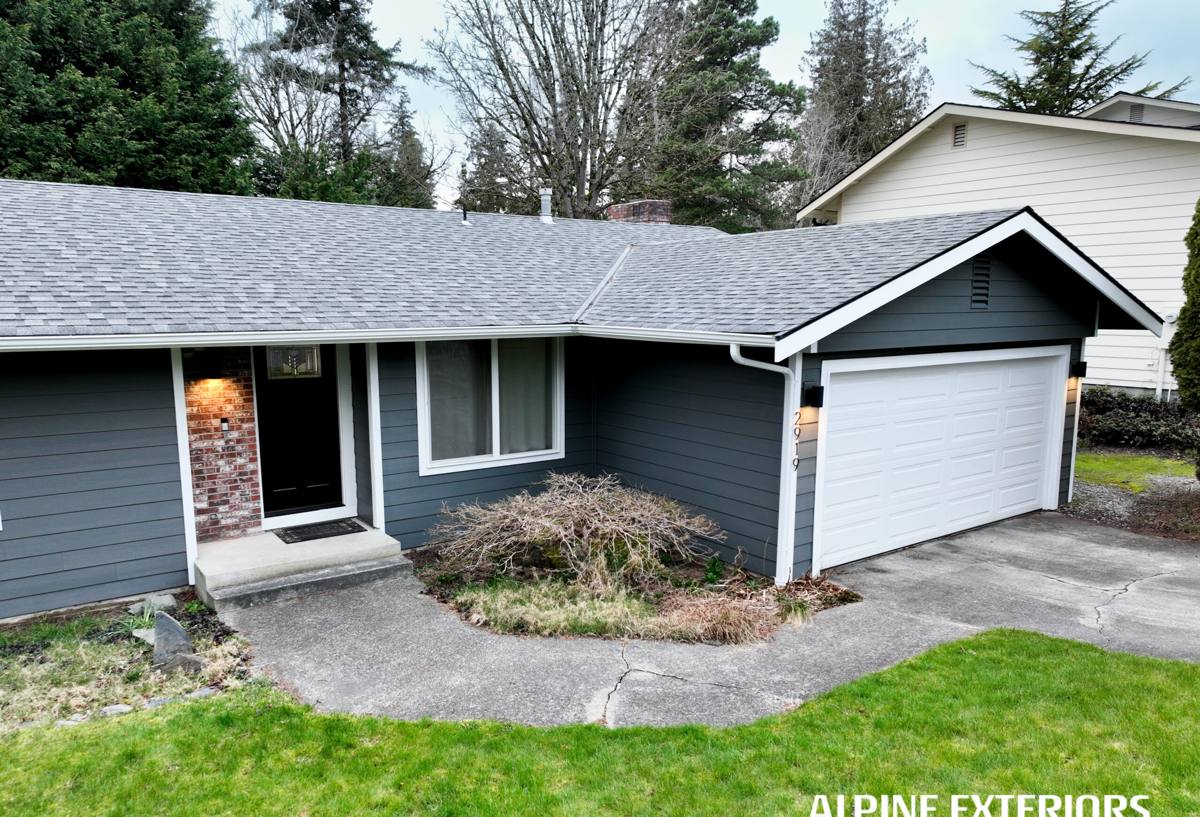
What "Correct" Siding Actually Needs to Do Here
Shed Water, Don't Absorb It
Wood-based products, including primed spruce and cedar, are organic materials — they take on moisture over time no matter how well they're finished, and once moisture is inside the material, freeze-thaw cycles and fungal growth do the rest. Fiber cement doesn't have that vulnerability in the same way; it's not immune to water problems caused by bad installation, but the material itself isn't food for rot and mold the way wood is.
Resist the Damp Without Constant Upkeep
A lot of Bellevue homeowners we talk to are tired of a yearly cycle of pressure washing, re-caulking, and spot-painting siding that's degrading faster than it should. Products that need frequent recoating or sealing to keep water out are a maintenance commitment that doesn't fit most people's schedules, especially through a wet Pacific Northwest winter when exterior work isn't practical anyway.
Hold Color and Finish Through Gray Winters
UV exposure isn't the primary threat here the way it is in sunnier climates, but humidity cycling and organic staining are. A finish that's baked on at the factory, rather than field-applied, holds up more evenly and resists the streaking and fading that shows up fastest on north- and west-facing walls.
Why We Standardized on James Hardie
We used to get asked why we don't offer vinyl, LP SmartSide, or other fiber cement brands like Cemplank or Allura. The honest answer is that we looked at how each of those products actually performs over 10, 20, and 30 years in a climate like ours, and James Hardie was the one we were comfortable putting our name behind, region after region, house after house.
- Non-combustible core — fiber cement doesn't feed a fire the way wood-based products can, which matters increasingly for insurance and code considerations.
- Engineered for regional climate — Hardie's HZ5 product line is specifically formulated for the Pacific Northwest's moisture and humidity profile, not a one-size-fits-all national product.
- Factory-applied ColorPlus finish — baked on under controlled conditions, backed by its own finish warranty, and far more consistent than field-painted siding.
- Long, transferable product warranty — one that survives a home sale, which matters if you're not planning to be in the house for 30 years.
- Track record — decades of real-world performance in wet coastal and marine climates similar to King County.
We're not against every alternative product on principle — each one has situations where it makes sense for someone. We just don't think this climate is the place to gamble on a lower-cost material and hope it performs as well long-term. That's a decision we make as installers who have to stand behind the work.
The HZ5 Line and What It's Actually Engineered For
James Hardie makes region-specific formulations, and HZ5 is the one built for climates like ours — places with sustained moisture, humidity swings, and freeze-thaw risk rather than extreme heat. The engineering difference isn't marketing language; it affects how the board is formulated to resist moisture-related damage over time, which is precisely the failure mode Bellevue's climate creates. When we quote a Hardie job, HZ5 is the baseline we're working from, not an upsell.
ColorPlus vs. Field-Applied Paint
| Factor | ColorPlus Factory Finish | Field-Applied Paint |
|---|---|---|
| Application conditions | Controlled factory environment | Weather-dependent, on-site |
| Coverage consistency | Multi-coat, baked-on, uniform | Varies by crew, weather, and coats applied |
| Warranty | Separate finish warranty from Hardie | Typically the paint manufacturer's standard warranty |
| Repaint interval | Extended vs. field-applied paint | Shorter, especially in wet climates |
| Touch-up need in first years | Minimal if installed correctly | More common, especially at joints and cuts |
What Correct Installation Looks Like on a Bellevue Home
Fiber cement siding is only as good as the installation behind it. This is where a lot of the real-world problems with any siding product — Hardie included — actually come from. Given how much water this region throws at a house, we treat the details most crews skip as the whole point of the job.
Water Management Behind the Siding
Correct installation starts with a properly lapped weather-resistive barrier and, where the wall assembly calls for it, a rainscreen gap that lets any moisture that gets behind the siding drain and dry out rather than sit against the sheathing. Flashing at windows, doors, and every horizontal trim transition has to be sequenced correctly — installed in the right order relative to the water-resistive barrier — so water is always directed outward and down, never trapped.
Fastening and Clearances
Hardie has specific fastener spacing, embedment depth, and clearance requirements — including gaps at the ground, roofline, and any penetration — that exist specifically to prevent moisture wicking. Skipping these doesn't usually cause a visible problem in year one; it shows up as swelling, staining, or a warranty claim years down the line.
Joints, Caulking, and Trim
Butt joints, corners, and trim transitions are where water intrusion most often starts. We follow Hardie's installation specifications for joint treatment rather than defaulting to "caulk everything," which can actually trap moisture in the wrong spots.
Our Process for a Bellevue Siding Job
- On-site assessment — we look at your home's specific exposure: which walls take the worst driving rain, where shade and tree cover keep things damp longest, and what the existing wall assembly is doing right or wrong.
- Scope and product plan — HZ5 panel or lap siding selection, trim details, and a plan for water management specific to your home's exposures, not a generic spec sheet.
- Tear-off and inspection — removing old siding lets us actually see the sheathing and framing underneath, which is often where hidden moisture damage from a prior installation shows up.
- Water-resistive barrier and flashing — installed and sequenced to current best practice, not just "what's under there already."
- Installation to Hardie spec — correct fastening, clearances, and joint treatment throughout.
- Final walkthrough — we go over the finished work with you, including care and maintenance specifics for your home's exposure.
Cost Factors on a Bellevue Project
We don't publish blanket prices because every home is different, but these are the factors that actually move the number on a Bellevue siding job:
| Factor | Why It Matters |
|---|---|
| Home size and wall complexity | More corners, dormers, and trim details mean more labor and cut waste |
| Existing wall condition | Sheathing repair or rot remediation found during tear-off adds scope |
| Siding profile | Lap siding, panel systems, and shingle-style profiles differ in material and labor cost |
| Trim and accessory work | Window trim, corner boards, and fascia detailing add to the total |
| Access and site conditions | Slopes, tight lot lines, and mature landscaping common in Bellevue neighborhoods can affect staging and labor time |
Maintenance: What Ongoing Care Actually Looks Like
One of the appeals of Hardie siding installed correctly is that ongoing care is genuinely light compared to wood-based alternatives. That doesn't mean zero maintenance — it means the maintenance that matters is simple and infrequent.
- Rinse siding periodically to keep organic buildup, especially moss and algae on shaded or north-facing walls, from taking hold
- Keep gutters clear so overflow doesn't run down the wall face and stay wet longer than it should
- Trim back vegetation and tree limbs that keep a wall section shaded and damp through the wet months
- Inspect caulking at trim joints every year or two and touch up as needed
- Address any impact damage promptly rather than letting a chipped edge sit exposed through a wet winter
Why Hiring a Crew That Already Works in Bellevue Matters
A siding job that looks right in a dry climate can still fail here if the installer isn't accounting for how much water this region actually deals with and how long it stays around. Crews who work Bellevue and the broader King County area regularly know which exposures on a given lot type tend to hold moisture, how local wall assemblies are typically built, and where past installations in this area tend to go wrong. That local pattern recognition is hard to replace with a generic install crew working from a national spec sheet alone.
It also matters for accountability. A local company answers to local homeowners and stands behind the work with people who are still around, still reachable, and still working in the same neighborhoods years later.
If you're weighing a siding replacement or repair in Bellevue, we're happy to take a look at your home and give you a straightforward, no-pressure estimate — including an honest read on what your specific exposures need, not just a generic quote.